The Midnight Congregation
A three-faction occult social deduction game
A secret order gathers at night to complete a forbidden ritual. Most members are true believers. But heretics smile and nod while quietly poisoning every step, and somewhere at the table sit the Townsfolk, who can't even tell the faithful from the frauds. Accuse, vote, lynch — and pray the thing you summon isn't in the mood for public executions.
0. What's in the Box
Cards:
- 45 component cards (15 types × 3 copies)
- 10 Quirk cards
- 11 Judgment cards (including 1 Silence card)
-
13 faction cards
- 6 x Townsfolk
- 4 x Cultist
- 3 x Heretic
-
13 role cards
- 5 x Townsman
- 1 x Marshal
- 3 x Cultist
- 1 x Custodian
- 2 x Heretic
- 1 x Defiler
-
13 power cards
- 10 x Congregant
- 1 x Oracle
- 2 x Cultist
- 1 x Inquisitor
- 1 x Medium
Board:
-
3 god boards
- small (5–7 players)
- medium (8–10 players)
- large (11–13 players)
Markers & Tokens:
- 1 x High Priest marker
- 1 x Jail marker
- 1 x Chaos token
- 1 x Devotion token
- 1 x Disruption token
- 8 x Resolution tokens (placed on required components when gathered)
1. Game Components
Markers
High Priest Marker

Placed in front of the current High Priest. Passes to the next confirmed High Priest each round. The player holding this marker controls the Officiant Phase.
Jail Marker
Placed in front of a jailed player by the Marshal, secretly while the table has their eyes closed. A player with the jail marker in front of them is out of the game until the Marshal removes it at the start of a round — at which point the Marshal's role is publicly revealed — or until 3 turns have passed, after which the player is released automatically.
Tokens
Devotion Token

Tracks progress on the Devotion track. Advances by 1 each time a required component is resolved. When it reaches the end of the track, the Finalization Round begins.
Disruption Token

Tracks progress on the Disruption track. Advances by 1 each time a non-required component is resolved. If it reaches the end of the track before Devotion, the Townsfolk win immediately.
Chaos Token

Tracks the Chaos counter. Advances by 1 each time a nomination is rejected. When it reaches 3, a random component resolves immediately and the counter resets to 0.
Resolution Tokens

Placed on required components on the ritual track when they are successfully gathered for the first time. A component with a resolution token can still be submitted and played — but resolving it again advances neither Devotion nor Disruption. 8 resolution tokens are included, one per maximum ritual track slot.
Faction Cards
Each player receives one faction card at setup, dealt secretly. This card identifies which faction the player belongs to — Townsfolk, Cultist, or Heretic — and is kept hidden at all times. Faction cards are never voluntarily revealed during normal play. They are only shown when a game effect specifically requires it. When revealed privately, only the viewing player sees it. When revealed publicly, it remains face-up in front of that player for the rest of the game.


Role Cards
Each faction has one secretly assigned role card. The Marshal (Townsfolk), Custodian (Cultists), and Defiler (Heretics) are always in the game regardless of player count — one special role per faction, every session. Remaining players within each faction receive ordinary role cards (Townsman, Cultist, Heretic). Role identities are never revealed at setup — they are discovered through play or revealed only when the holder acts. Faction roles are lost if the holder is lynched and are never transferred.
THE TOWNSMAN
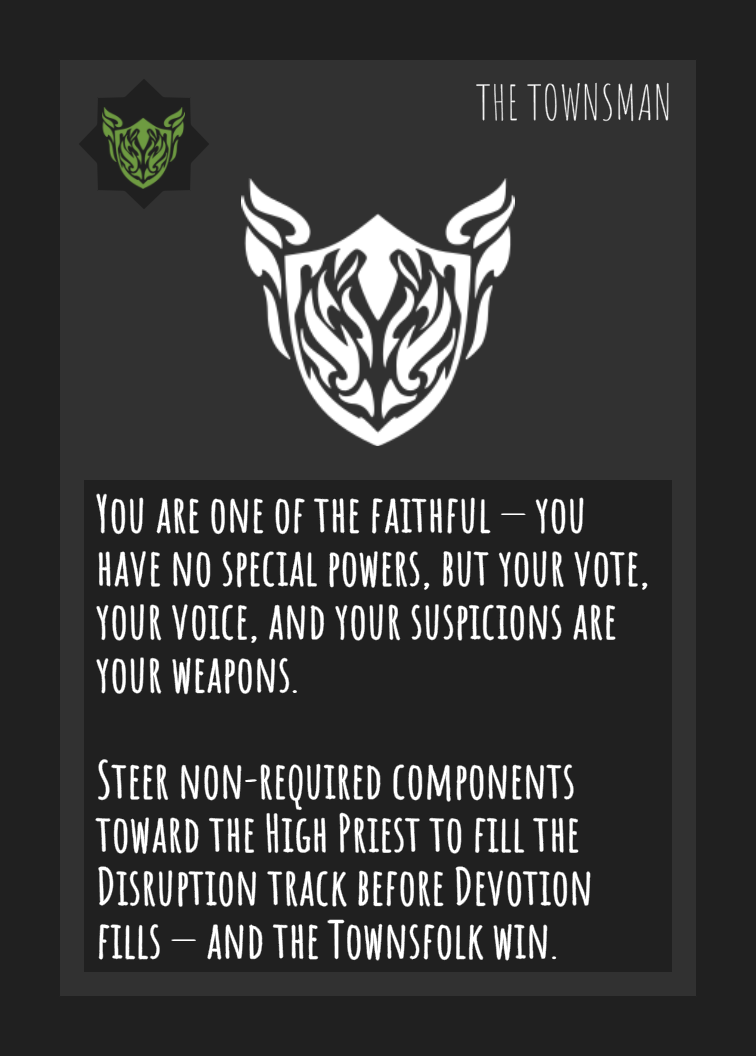
You are one of the faithful — you have no special powers, but your vote, your voice, and your suspicions are your weapons. Steer non-required components toward the High Priest to fill the Disruption track before Devotion fills — and the Townsfolk win.
THE MARSHAL
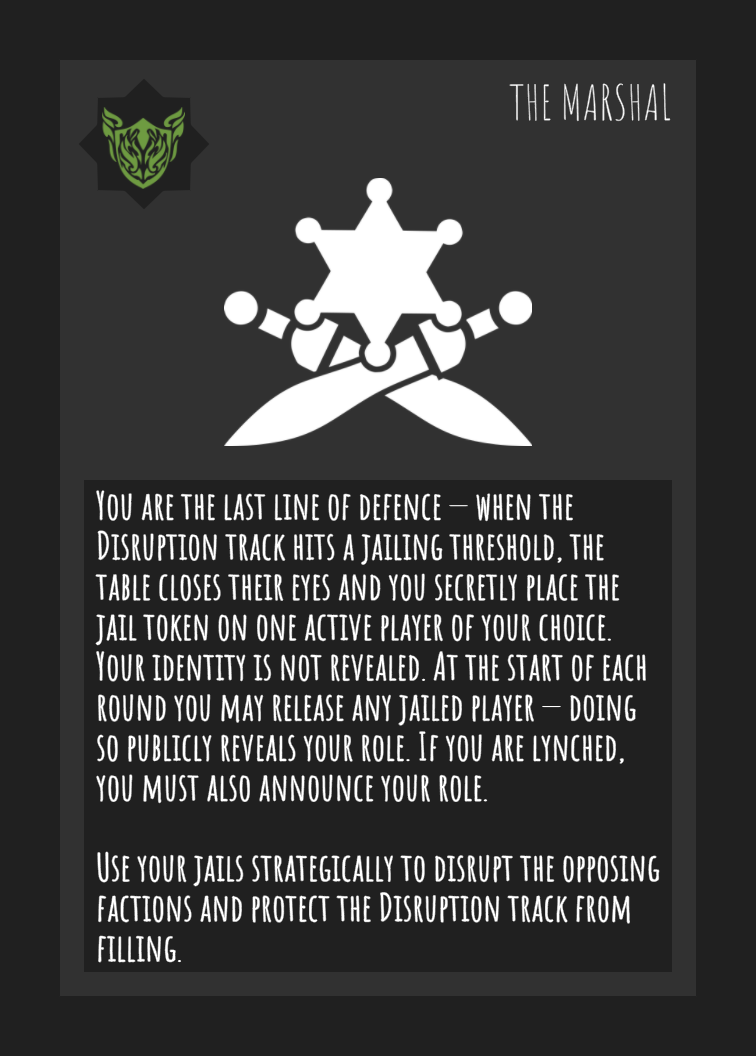
You are the last line of defence — when the Disruption track hits a jailing threshold, the table closes their eyes and you secretly place the jail token on one active player of your choice. Your identity is not revealed. At the start of each round you may release any jailed player — doing so publicly reveals your role. Jailed players are also released automatically after 3 turns, whether you act or not. If you are lynched, you must also announce your role. Use your jails strategically to disrupt the opposing factions and protect the Disruption track from filling.
THE CULTIST
You are a true believer — you have no special powers, but your submissions, your nominations, and your silence serve the ritual. Ensure a Cultist High Priest calls the god in the Finalization Round.
THE CUSTODIAN
You are the ritual's protector — once per game, reveal this card immediately after a non-required component is resolved, fully nullifying the Disruption increment and cancelling any triggered jailing. Note: playing an already-resolved required component generates neither Devotion nor Disruption — the Custodian's power does not apply in that case. Revealing yourself is the cost. Protecting the ritual is the purpose.
THE HERETIC
You are a saboteur hiding in plain sight — you have no special powers, but every required component resolved brings the Devotion track closer to the Finalization Round. Ensure a Heretic claims the High Priest role and seizes the ritual in the Finalization Round.
THE DEFILER
You are corruption made flesh — once per game during the Finalization Round, you may choose to cast your vote with the weight of 2 votes instead of 1 in the confirmation vote. One voice. Two votes. Use it wisely.
Power Cards
Power cards are randomly assigned across any faction — a role claim reveals nothing about loyalty. All powers activate during the Power Window (step 7 of the round loop). Each power may be used once per round and a maximum of 2 times per game. Oracle and Inquisitor powers are lost if the holder is lynched. The Medium retains their power even while lynched.
Power card inclusion scales with player count:
- 5–6 players: Medium only — all other power cards are Congregants
- 7–9 players: Medium + Oracle — all other power cards are Congregants
- 10–13 players: Medium + Oracle + Inquisitor — all other power cards are Congregants
CONGREGANT
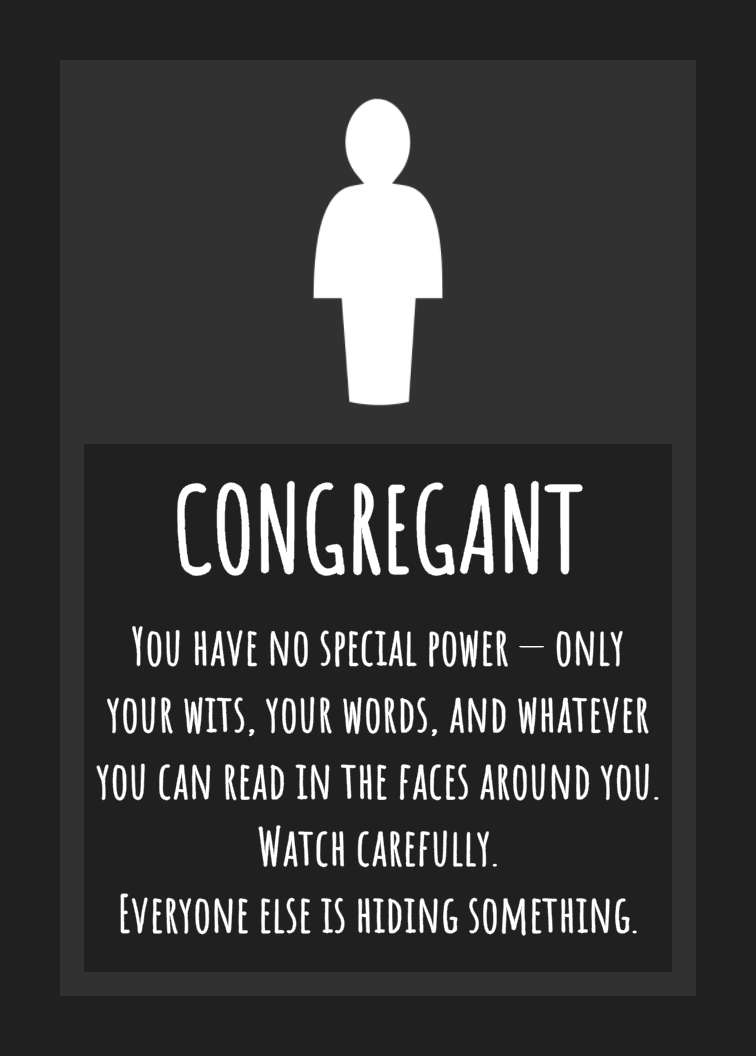
"I wish to... actually, never mind."
You have no special power — only your wits, your words, and whatever you can read in the faces around you. Watch carefully. Everyone else is hiding something.
ORACLE
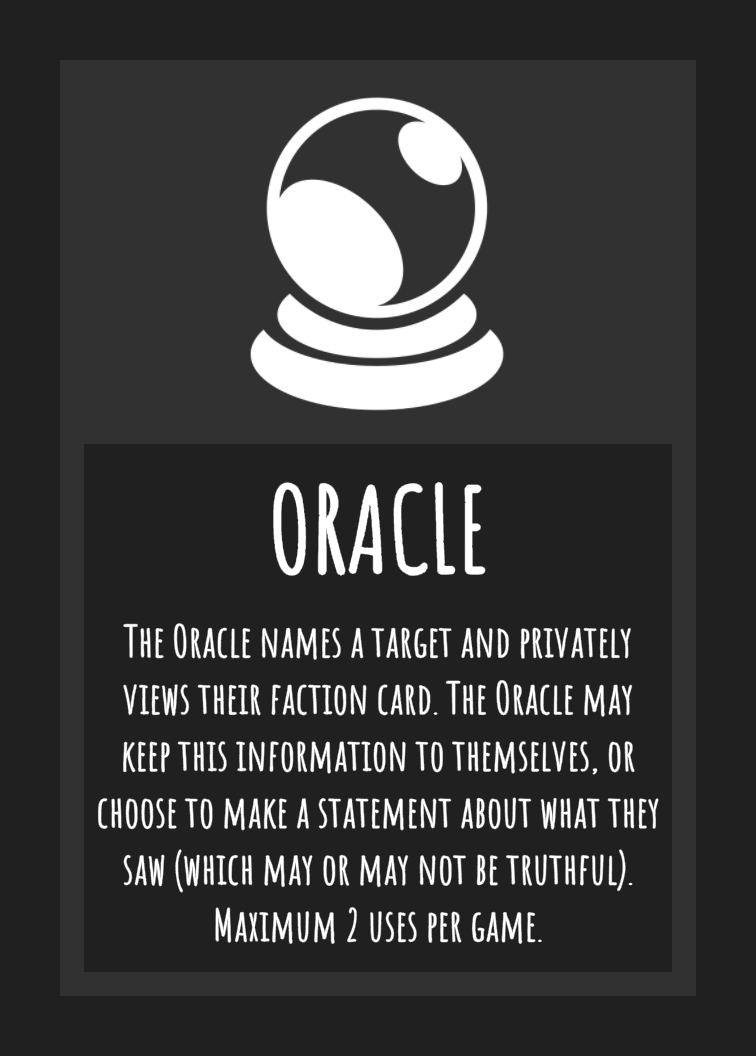
"I wish to consult the Oracle."
The Oracle names a target and privately views their faction card. The Oracle may keep this information to themselves, or choose to make a statement about what they saw — which may or may not be truthful. Maximum 2 uses per game.
INQUISITOR
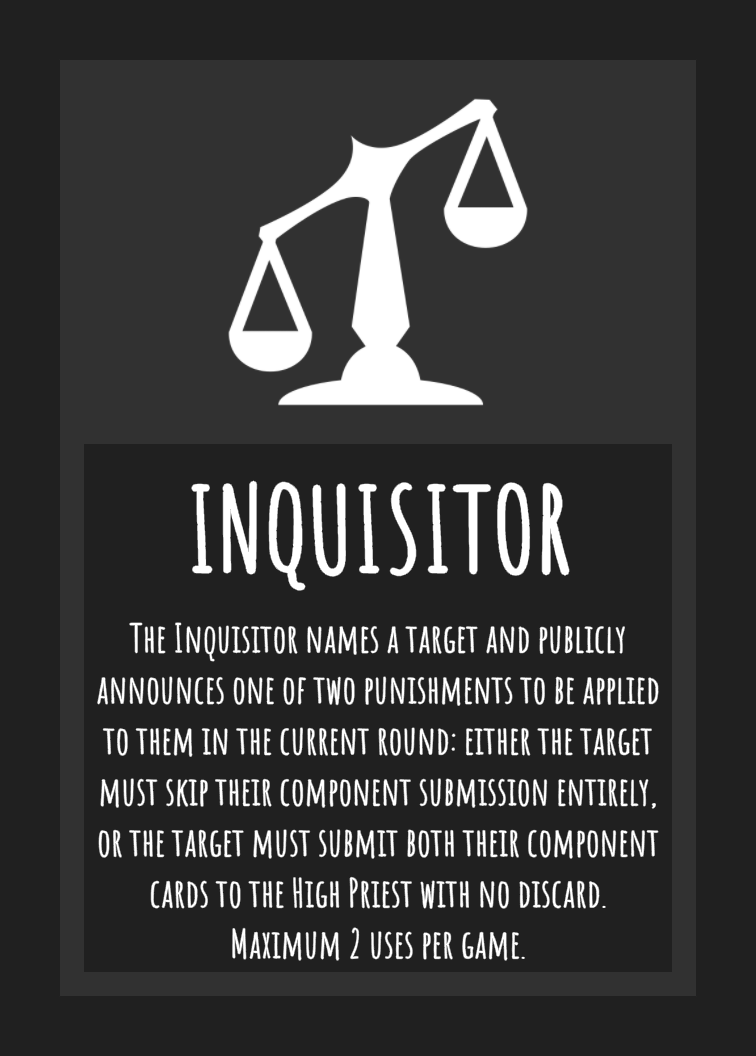
"I wish to enforce inquisition on [Player]."
After the High Priest has chosen the participating players, the Inquisitor may activate their power before component submission. The Inquisitor names one of the chosen players and publicly announces their punishment: either the target must skip their component submission entirely, or the target must submit both their component cards to the High Priest with no discard. Maximum 2 uses per game.
MEDIUM
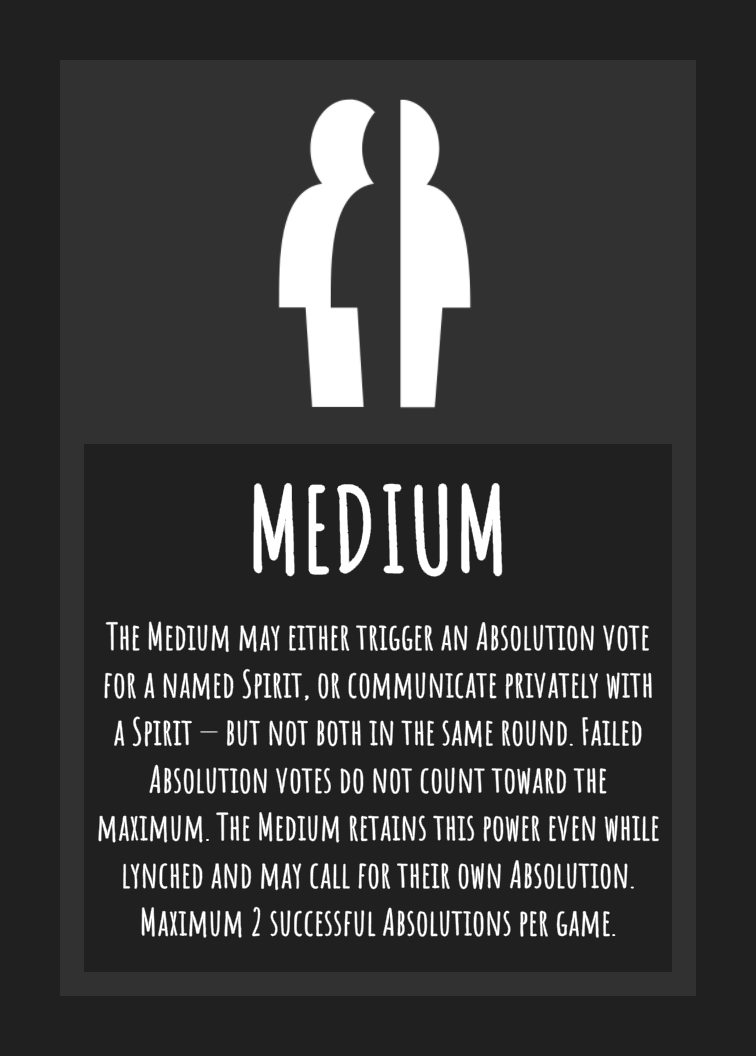
"I wish to call for the Absolution of [Spirit]."
The Medium is the only way to reinstate a lynched Spirit. The Medium names a Spirit and triggers an immediate Absolution vote. The table votes yes/no — majority yes returns the Spirit to full active status. If the vote fails, this use does not count toward the Medium's maximum. The Medium retains this power even while lynched. Maximum 2 successful Absolutions per game (3 under Q5). The Medium may also use their Power Window to communicate privately with any Spirit instead of calling for Absolution — but not both in the same round. Spirit communication is private and the Spirit is not required to be truthful.
Component Cards
Component cards form the central draw deck of the game. Each round, players draw 2 component cards, discard one, and submit one face-down to the High Priest. Components are either required or non-required — required components advance the Devotion track when resolved, non-required components advance the Disruption track. Required components are placed face-up on the ritual track at setup. When a required component is resolved for the first time, a resolution token is placed on it — it remains visible and can still be played again.
Each component card has an action that takes effect when it is resolved. Most actions override the default High Priest succession — instead of the next nominee being the player to the left of the current High Priest, the component determines which seat the nominee comes from, or which two players the next High Priest must select to join the ritual. Two components have unique effects: one allows the current High Priest to immediately reinstate a Spirit without an Absolution vote, and one allows them to release a jailed player without the Marshal's approval. The default succession applies if no component action overrides it that round.
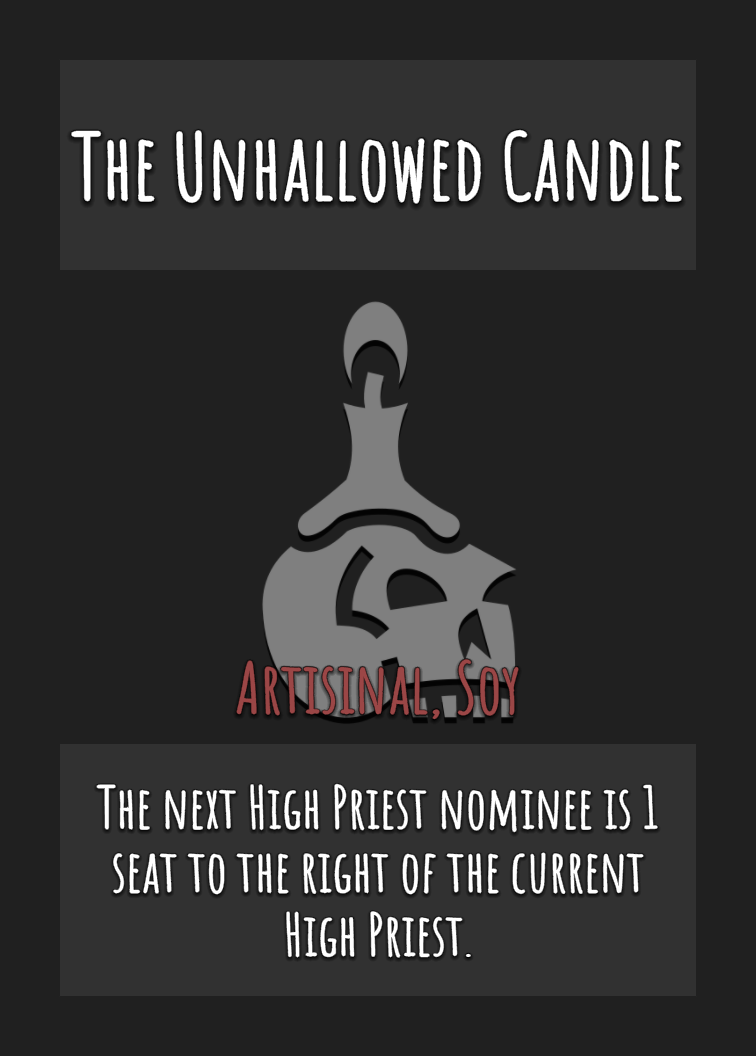 The Unhallowed
Candle
The next High Priest nominee is 1 seat to the right of the current High Priest.
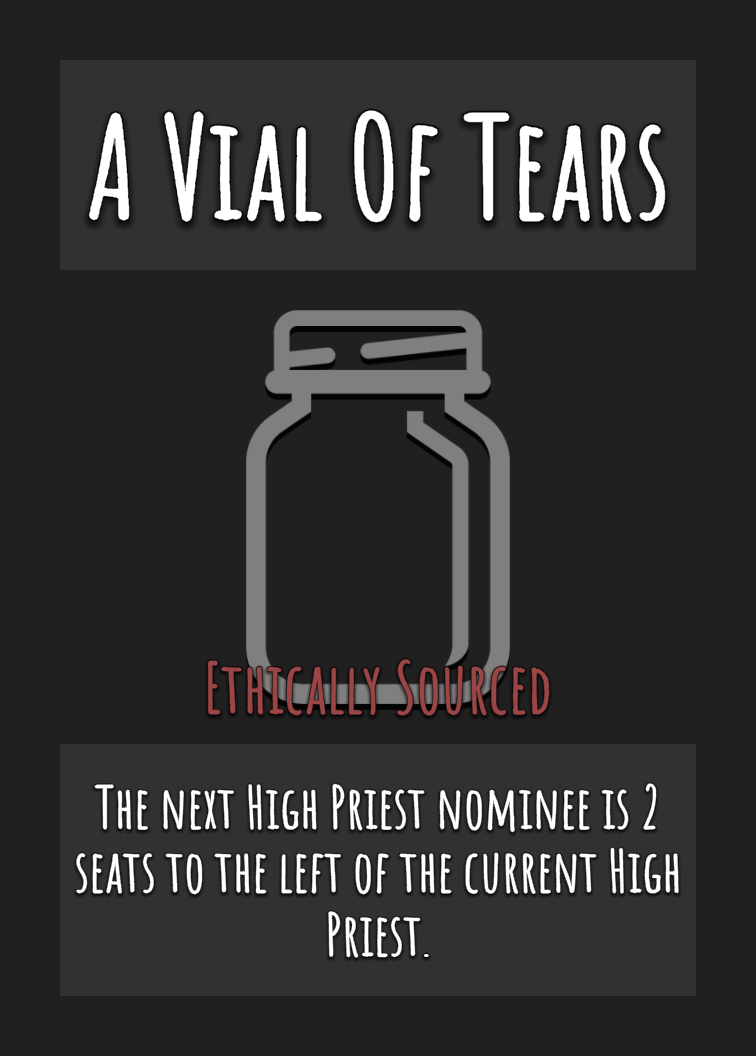 A Vial Of
Tears
The next High Priest nominee is 2 seats to the left of the current High Priest.
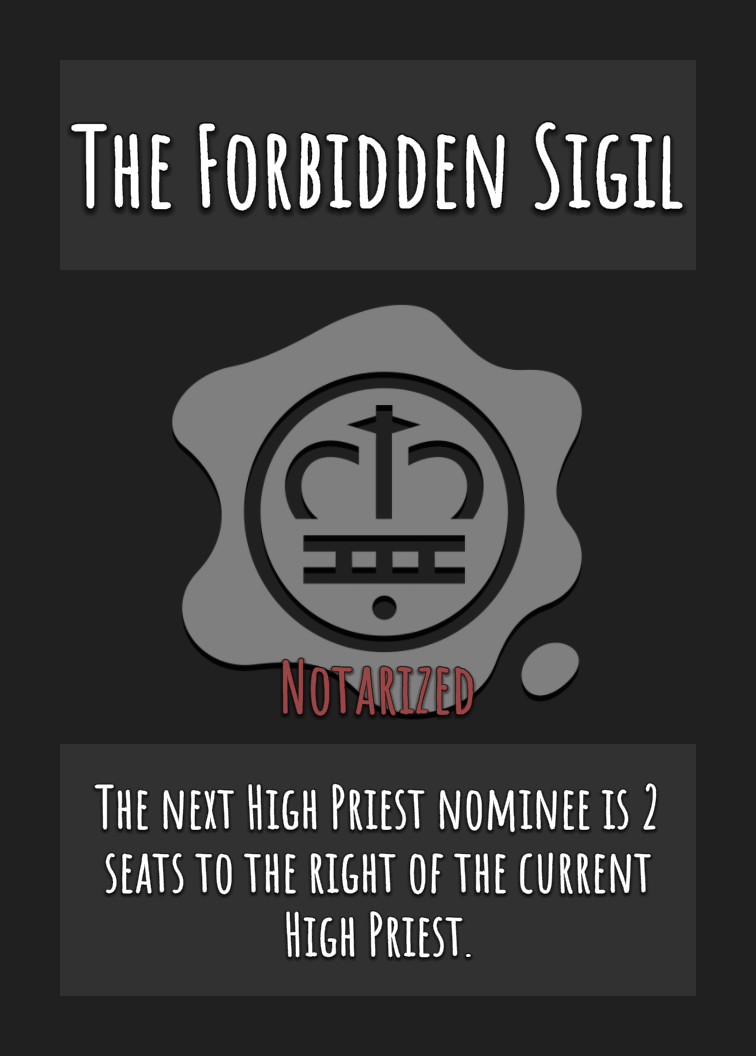 The Forbidden
Sigil
The next High Priest nominee is 2 seats to the right of the current High Priest.
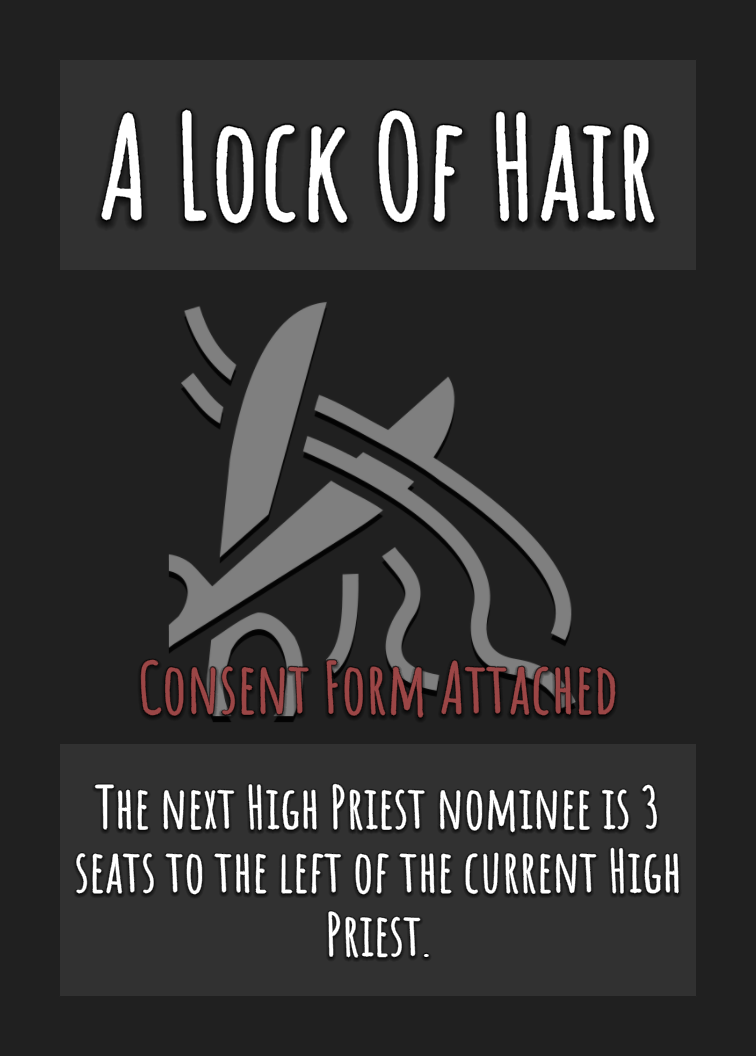 A Lock Of
Hair
The next High Priest nominee is 3 seats to the left of the current High Priest.
 The Midnight
Incantation
The next High Priest nominee is 3 seats to the right of the current High Priest.
 A Sacrificial
Offering
The next High Priest must select the 2 players immediately to their left and right.
 The Permit — Form
27-B/6
The next High Priest must select the 2 players immediately to their left.
 A Drop Of
Blood
The next High Priest must select the 2 players immediately to their right.
 The Unholy
Tome
The next High Priest must select the players 2 and 4 seats to their left.
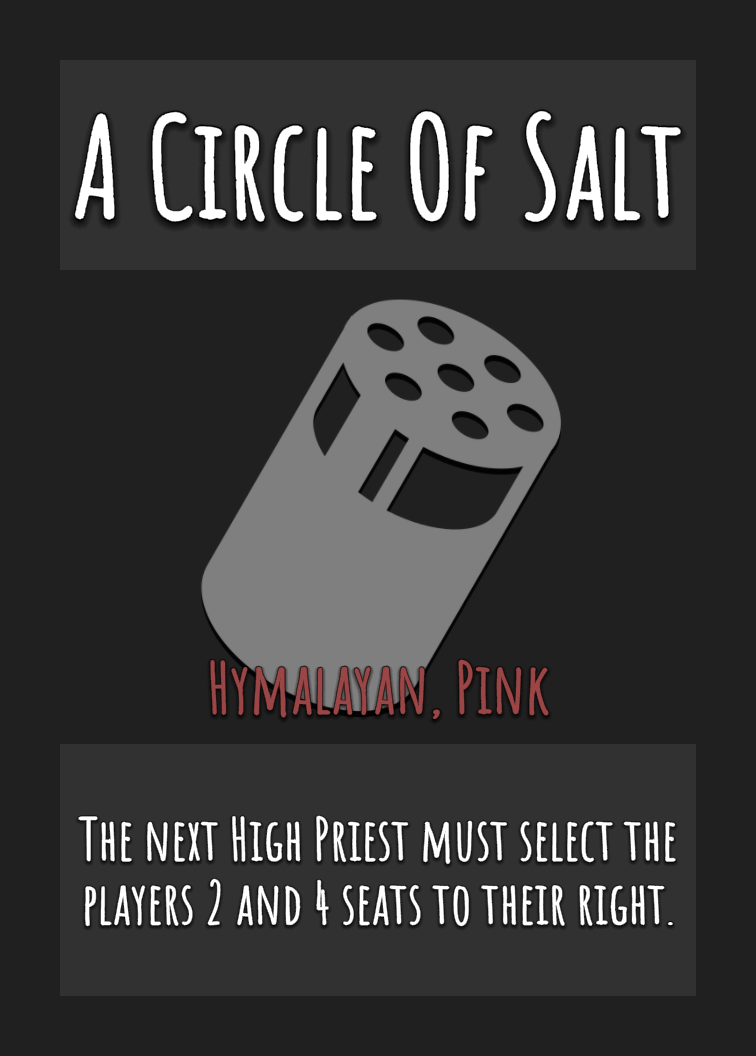 A Circle Of
Salt
The next High Priest must select the players 2 and 4 seats to their right.
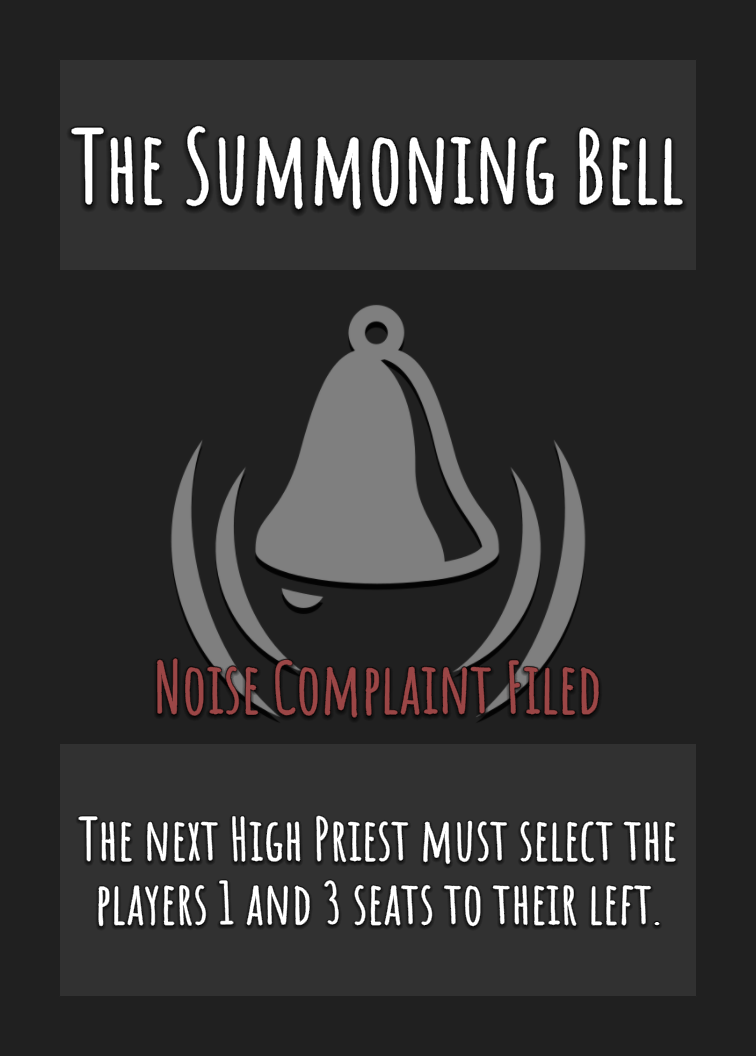 The Summoning
Bell
The next High Priest must select the players 1 and 3 seats to their left.
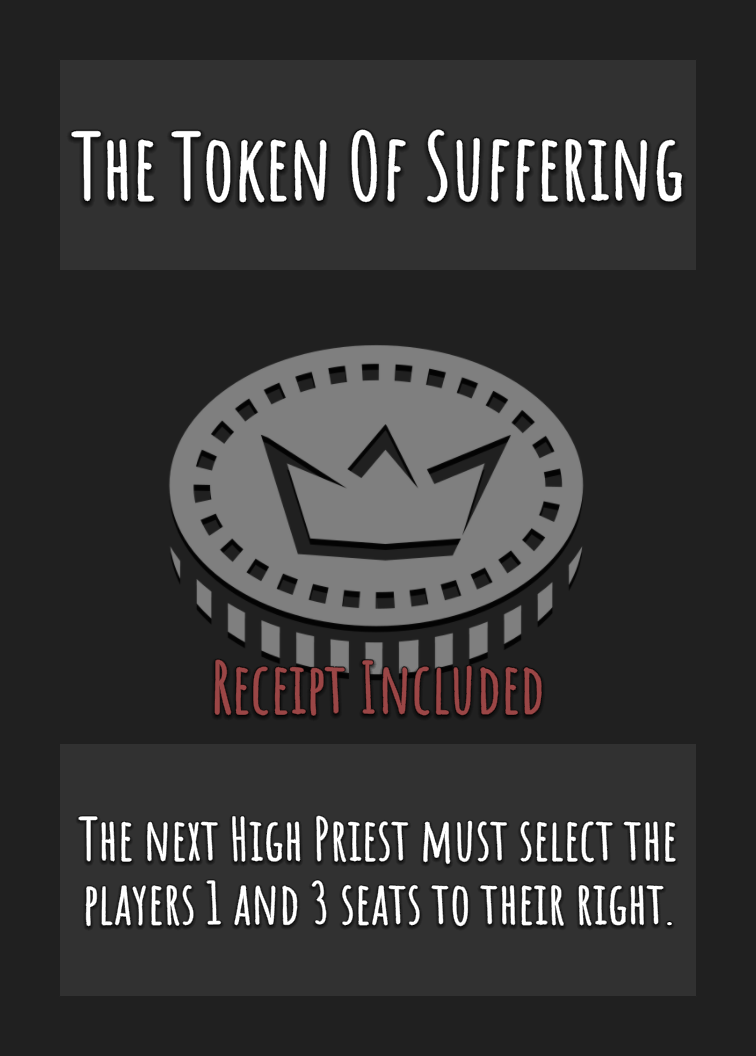 The Token Of
Suffering
The next High Priest must select the players 1 and 3 seats to their right.
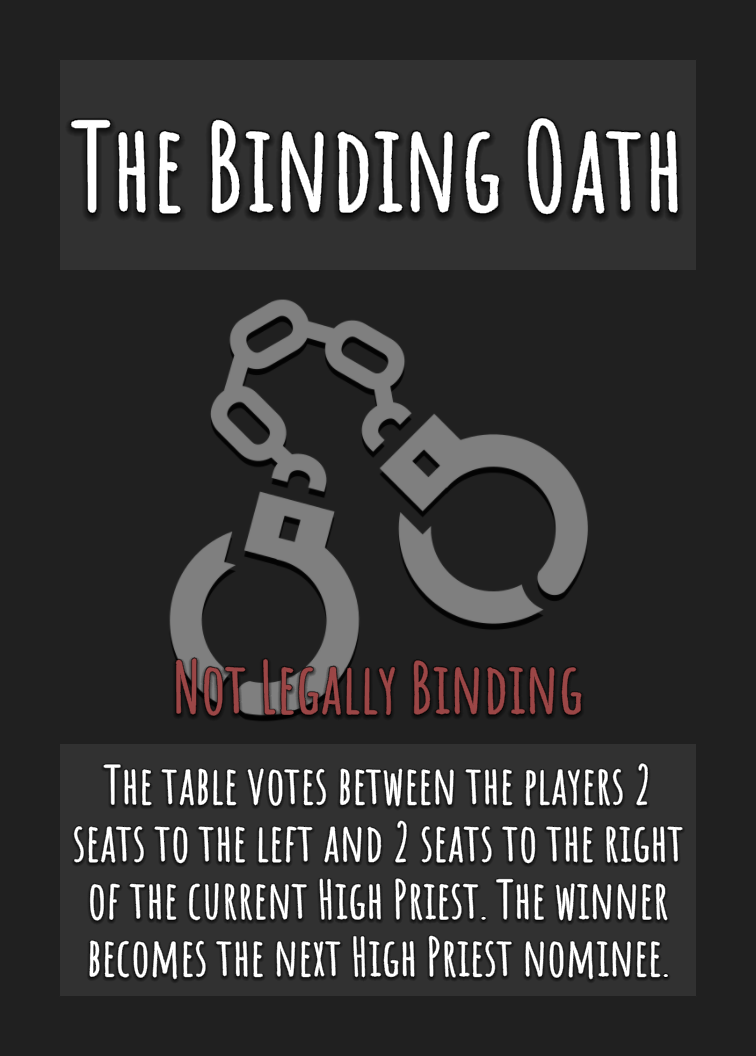 The Binding
Oath
The table votes between the players 2 seats to the left and 2 seats to the right of the current High Priest. The winner becomes the next High Priest nominee.
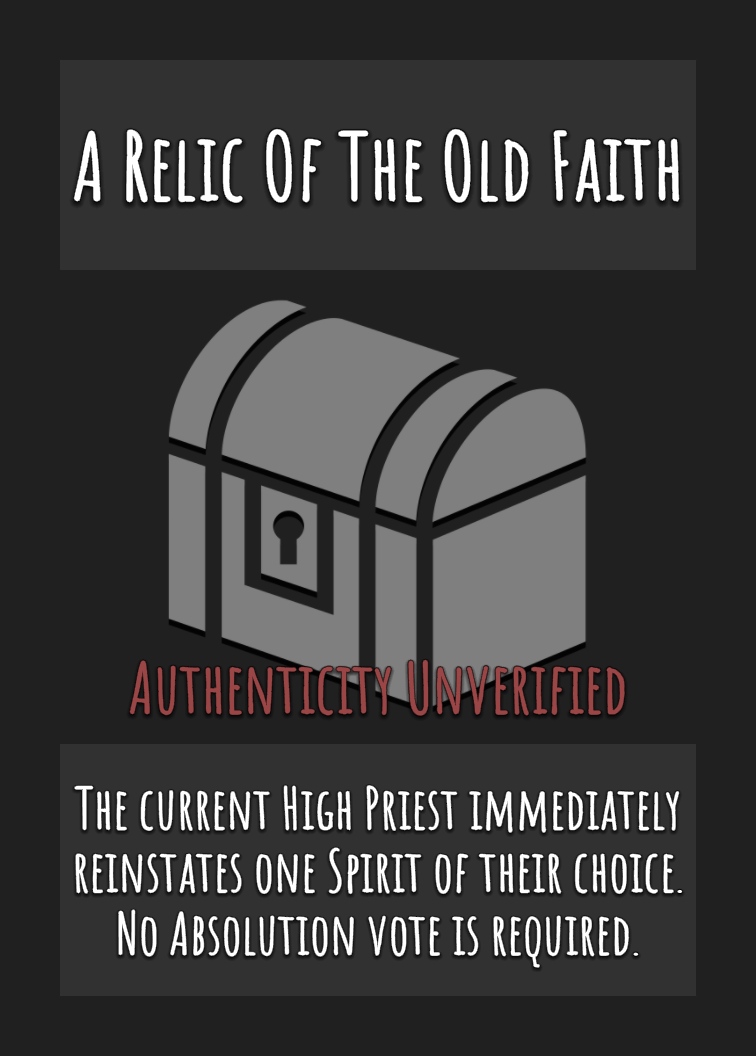 A Relic Of The
Old Faith
The current High Priest immediately reinstates one Spirit of their choice. No Absolution vote is required.
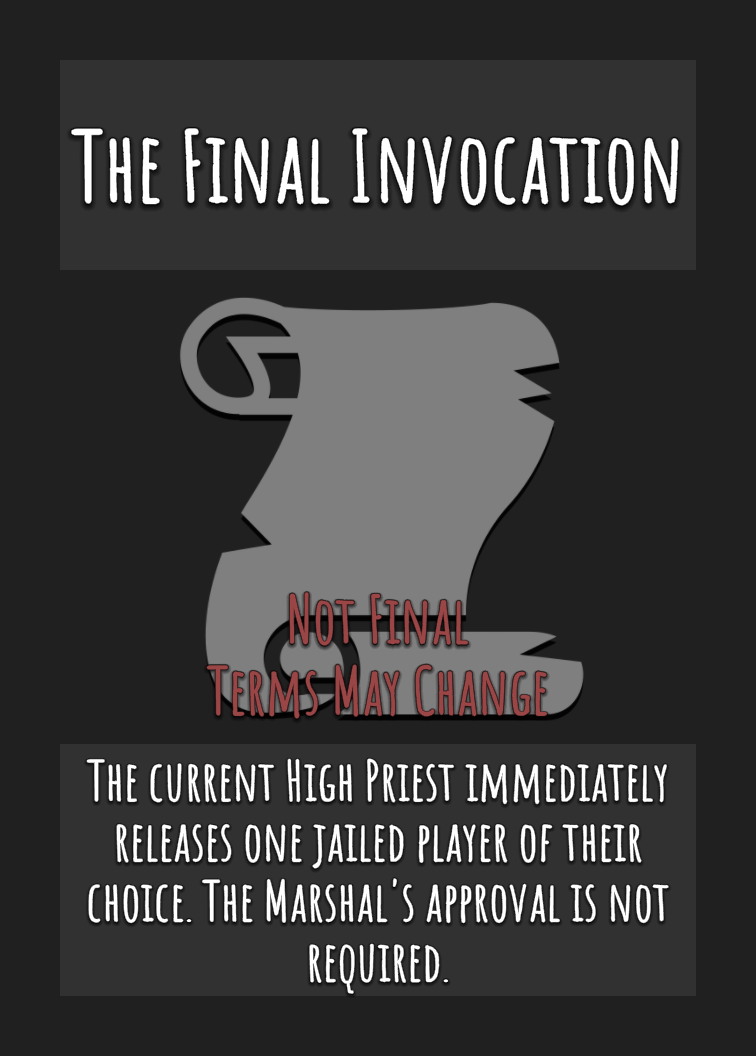 The Final
Invocation
The current High Priest immediately releases one jailed player of their choice. The Marshal's approval is not required.
Quirk & Judgement Cards
Quirk Cards
Quirk cards define the rule the god imposes on play for the entire game. One Quirk card is drawn at setup and placed face-up on the god board. The god's first name is printed on the Quirk card. Quirks never contain punishments — consequences belong to Judgment cards.
Gerald Q1
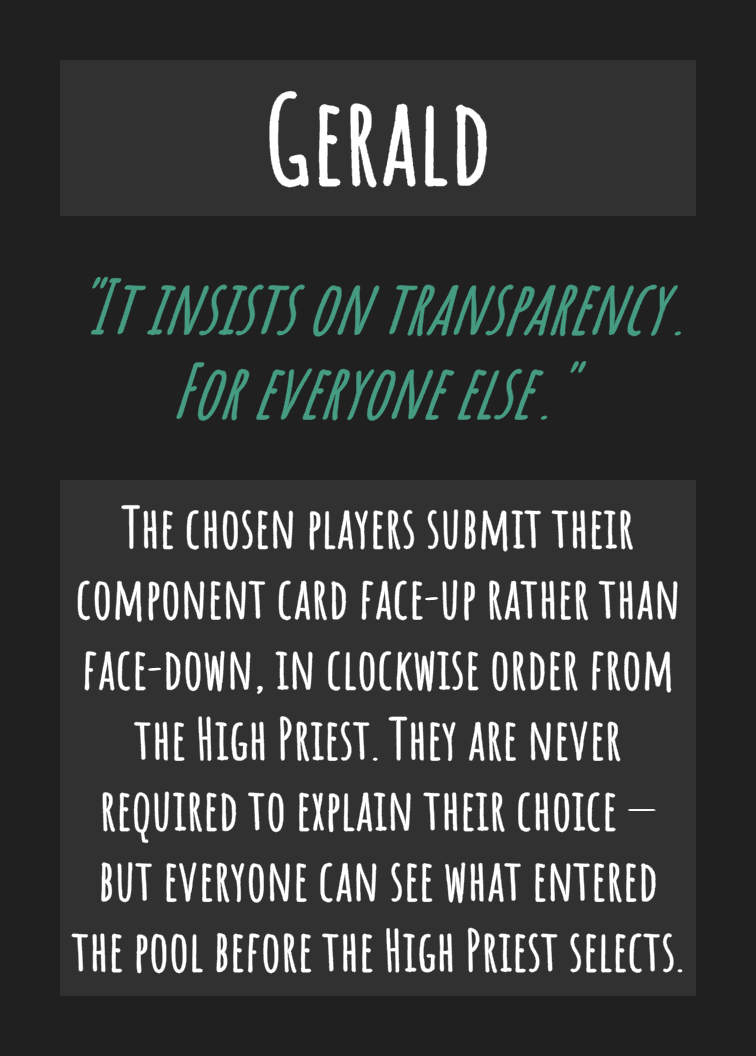
"It insists on transparency. For everyone else."
The chosen players submit their component card face-up rather than face-down, in clockwise order from the High Priest. They are never required to explain their choice — but everyone can see what entered the pool before the High Priest selects.
Inherent sway: Neutral · Moderate
Nul-Veth Q2
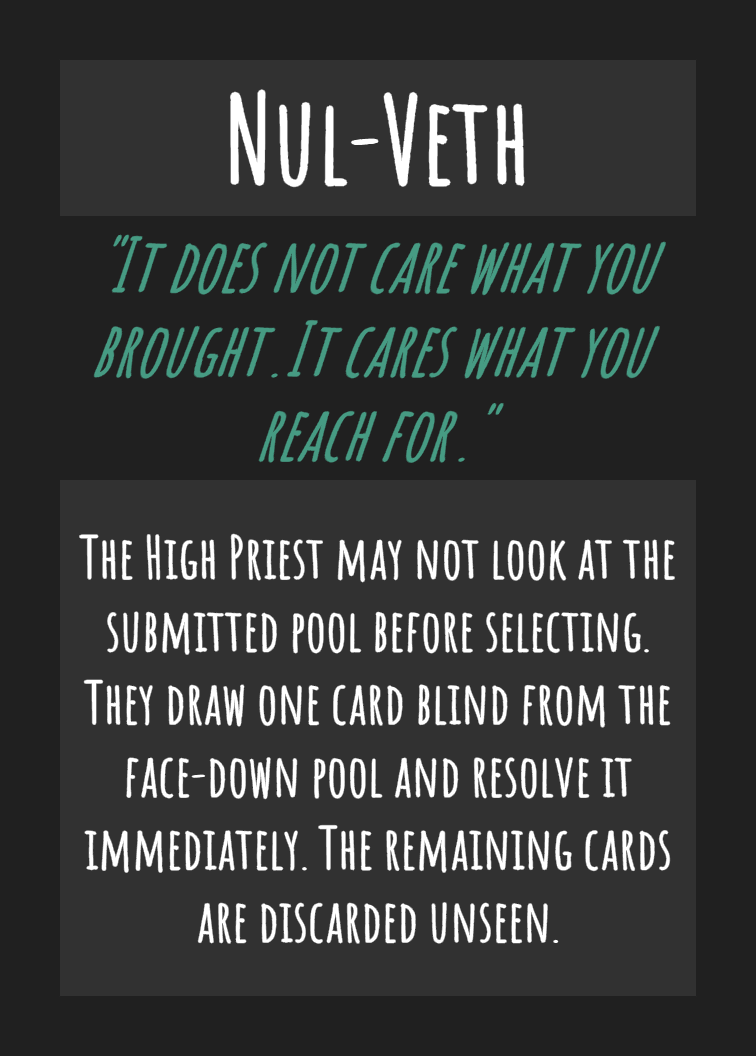
"It does not care what you brought. It cares what you reach for."
The High Priest may not look at the submitted pool before selecting. They draw one card blind from the face-down pool and resolve it immediately. The remaining cards are discarded unseen.
Inherent sway: Neutral · Strong
Kevin Q3
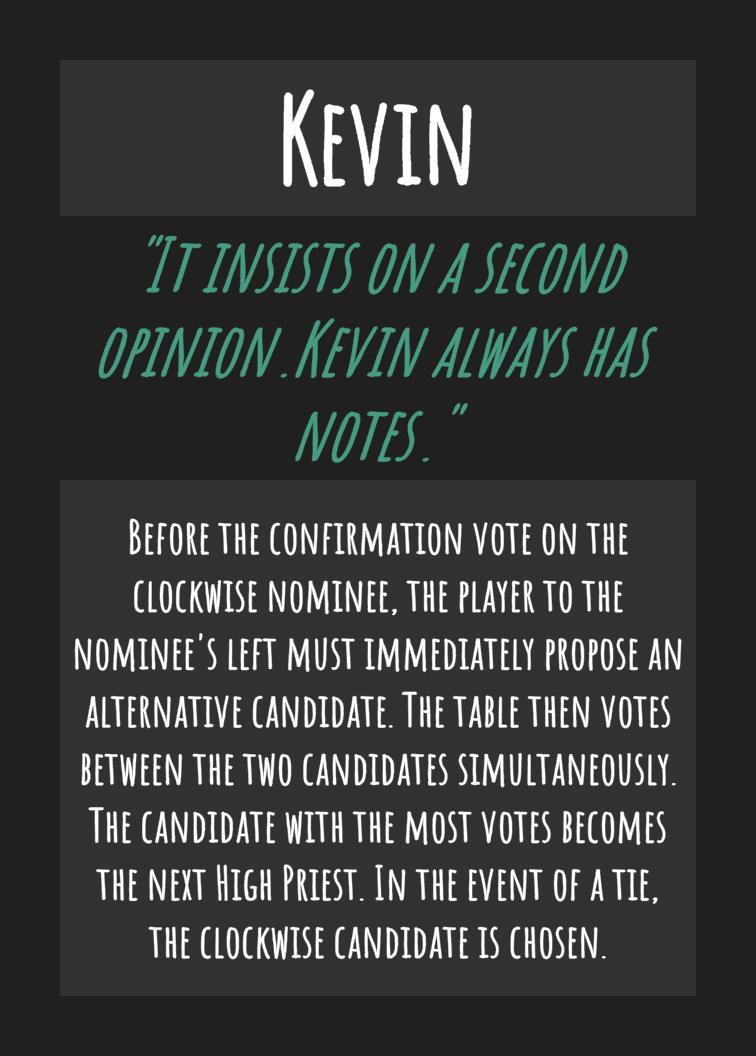
"It insists on a second opinion. Kevin always has notes."
Before the confirmation vote on the clockwise nominee, the player to the nominee's left must immediately propose an alternative candidate. The table then votes between the two candidates simultaneously. The candidate with the most votes becomes the next High Priest. In the event of a tie, the clockwise candidate is chosen.
Inherent sway: Neutral · Mild
Brenda Q4
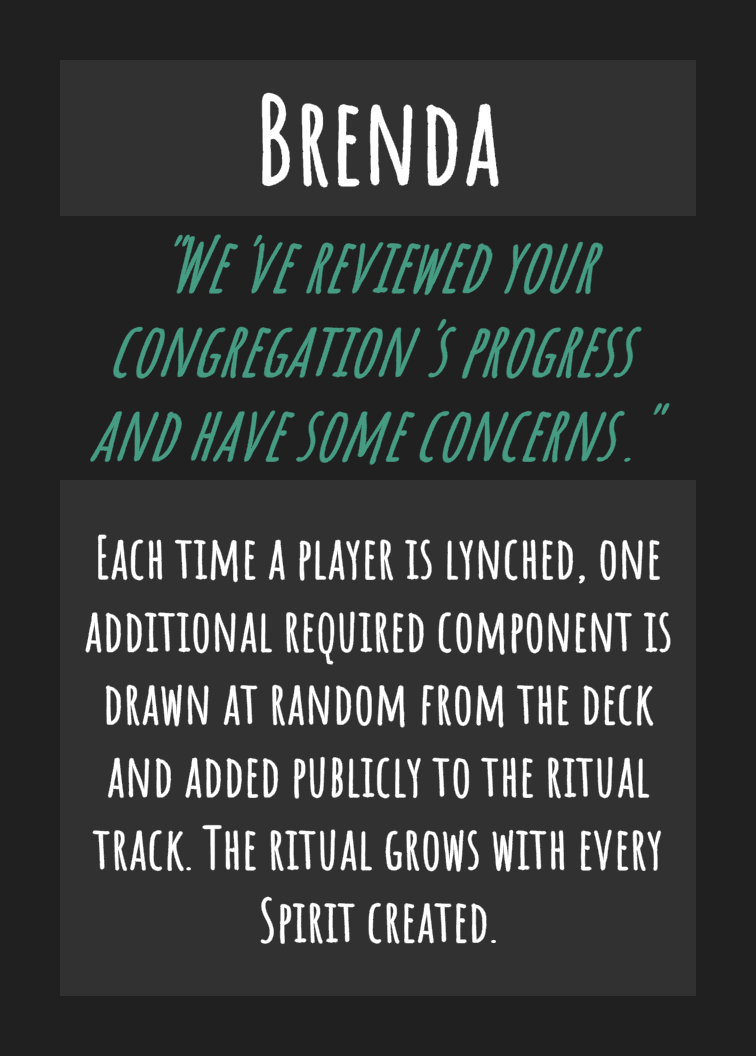
"We've reviewed your congregation's progress and have some concerns."
Each time a player is lynched, one additional required component is drawn at random from the deck and added publicly to the ritual track. The ritual grows with every Spirit created.
Inherent sway: Townsfolk · Strong
Morreth Q5
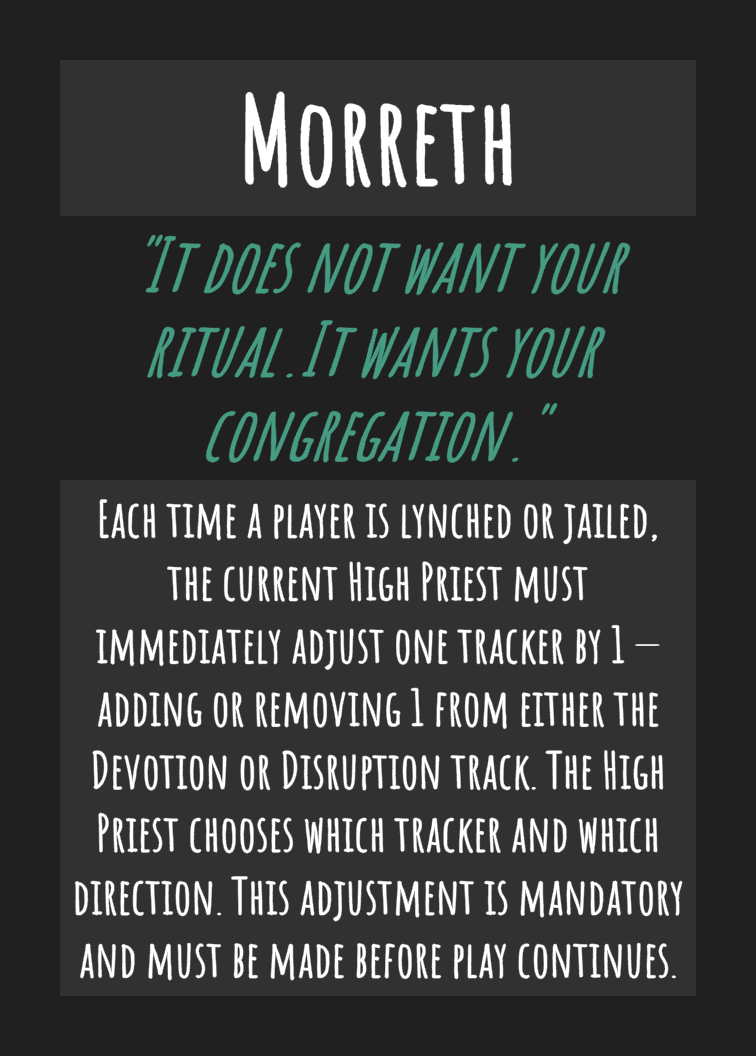
"It does not want your ritual. It wants your congregation."
Each time a player is lynched or jailed, the current High Priest must immediately adjust one tracker by 1 — adding or removing 1 from either the Devotion or Disruption track. The High Priest chooses which tracker and which direction. This adjustment is mandatory and must be made before play continues.
Inherent sway: Neutral · Strong
Phelgoras Q6
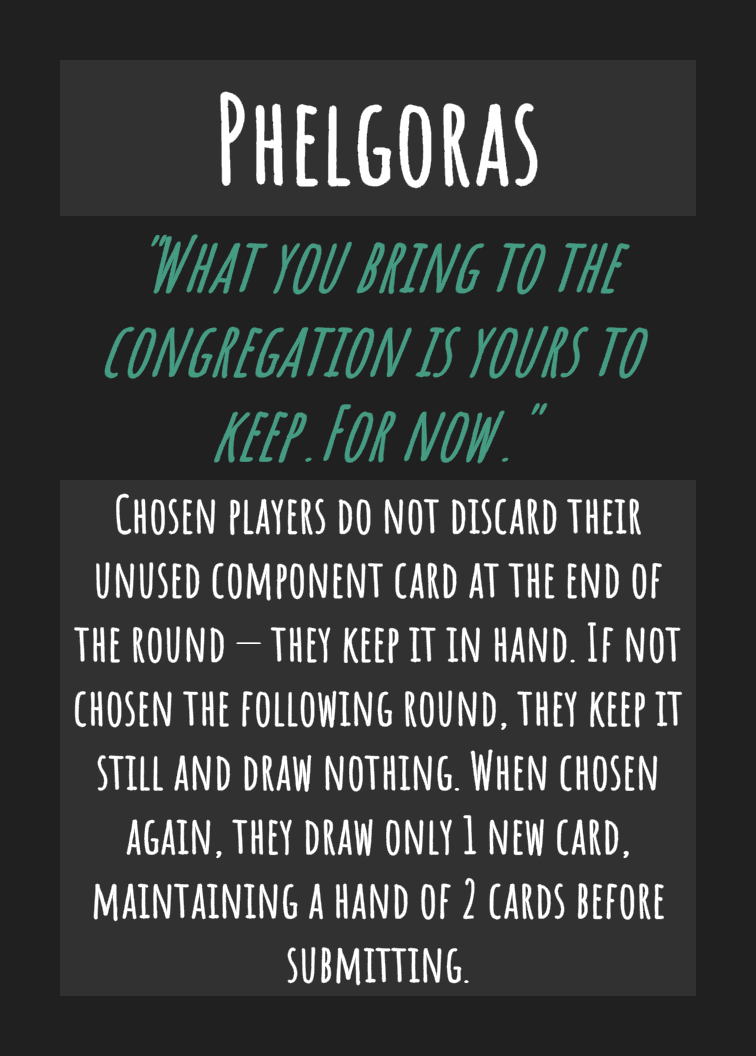
"What you bring to the congregation is yours to keep. For now."
Chosen players do not discard their unused component card at the end of the round — they keep it in hand. If not chosen the following round, they keep it still and draw nothing. When chosen again, they draw only 1 new card, maintaining a hand of 2 cards before submitting.
Inherent sway: Townsfolk · Strong
Mxl Q7
"It wants the congregation to see. Not everything. Just enough."
The High Priest selects 3 players instead of 2 each round. After selecting a component to resolve, the High Priest must publicly reveal one of the remaining submitted components before discarding the rest face-down. The High Priest chooses which one to reveal.
Inherent sway: Townsfolk · Mild
Orrindel Q8
"It offers a gift. Whether you take it reveals something about you."
At setup, the required component list is expanded by one — 6 components must be gathered instead of 5. Draw 3 component cards and place them face-up as a public Boon reserve. Before selecting from the submitted pool each round, the High Priest may take one card from the Boon reserve and add it to the pool. Once taken, a Boon card is gone. The reserve is not replenished.
Inherent sway: Townsfolk · Moderate
Greldo Q9
"It does not care for your politics. It wants to see who's lucky."
Nomination and vote phases are replaced entirely. All active players throw
simultaneously in a game of rock paper scissors. If all three signs appear, the
sign with the fewest throwers is eliminated — if two signs are tied for fewest,
both groups are eliminated. Standard RPS rules apply when only two signs are
thrown. Survivors repeat until one player remains and becomes High Priest.
Incompatible with: Judgement 2 - The Watchful (Chaos Count — no nominations means no
failed nominations)
Inherent sway: Neutral · Strong
Seraphis Q10
"It wants to see what you're holding. Everyone does."
All players hold their component cards face-out at all times — visible to everyone at the table except themselves, whether chosen or not. Submissions are still made face-down as normal. Players may never look at their own cards, and may never verbally or physically indicate to another player what they can see in their hand.
Inherent sway: Neutral · Moderate
Judgment Cards
Judgment cards add a second layer of god behaviour — Omens, Favours, or Wraths that trigger during play. One Judgment card is drawn at setup and placed face-up on the god board. The god's disposition is printed on the Judgment card. The Silence card is a special Judgment card that has no effect.
The Silent J0 Silence
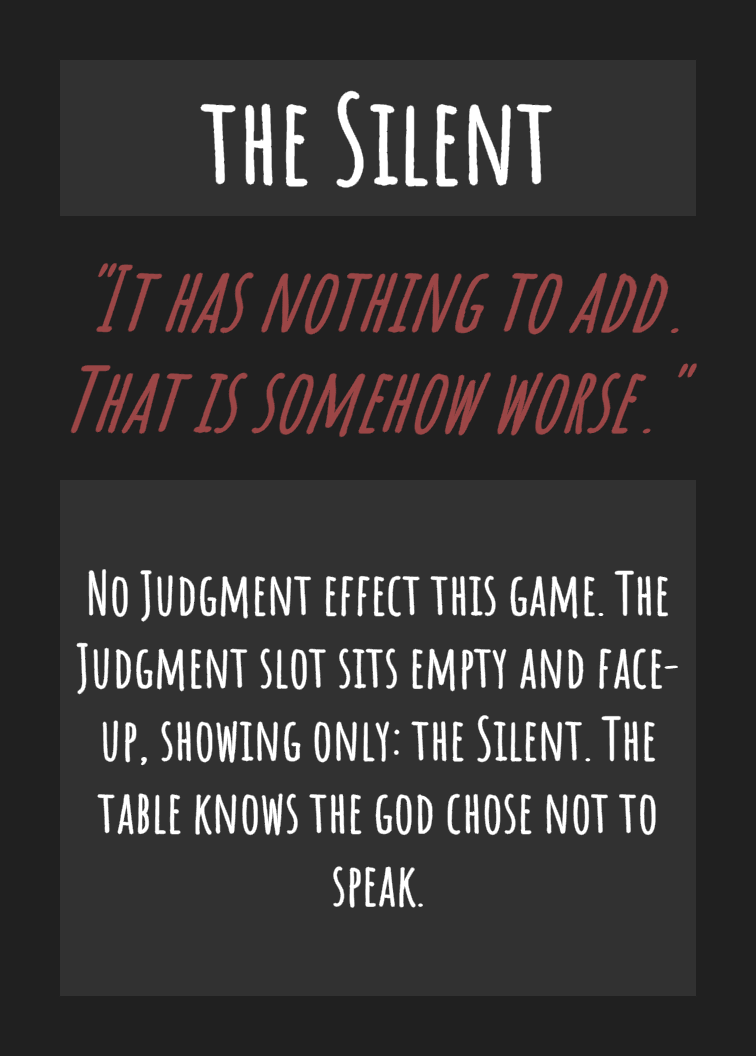
"It has nothing to add. That is somehow worse."
No Judgment effect this game. The Judgment slot sits empty and face-up, showing only: the Silent. The table knows the god chose not to speak.
Inherent sway: Neutral · Strong
The Impatient J1 Wrath
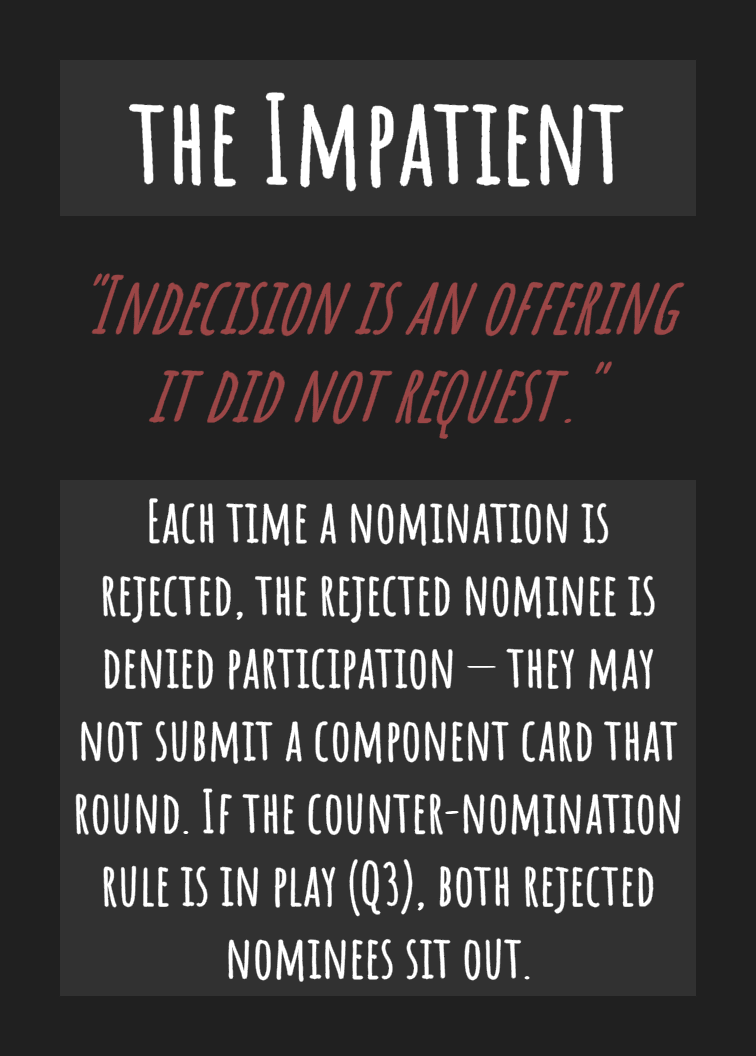
"Indecision is an offering it did not request."
Each time a nomination is rejected, the rejected nominee is denied participation — they may not submit a component card that round. If the counter-nomination rule is in play (Q3), both rejected nominees sit out.
Inherent sway: Cultists/Heretics · Moderate
The Watchful J2 Wrath
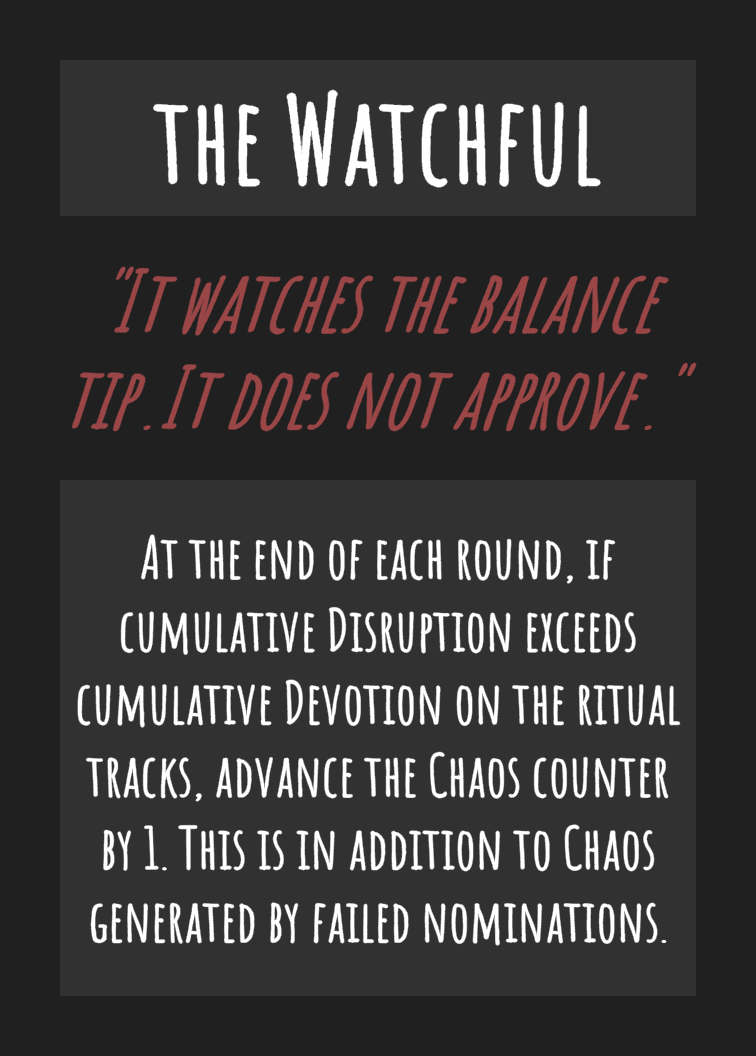
"It watches the balance tip. It does not approve."
At the end of each round, if cumulative Disruption exceeds cumulative Devotion on the
ritual
tracks, advance the Chaos counter by 1. This is in addition to Chaos generated by failed
nominations.
Incompatible with: Quirk 9 - Greldo (RPS tournament produces no failed
nominations)
Inherent sway: Townsfolk · Strong
The Generous J3 Favour
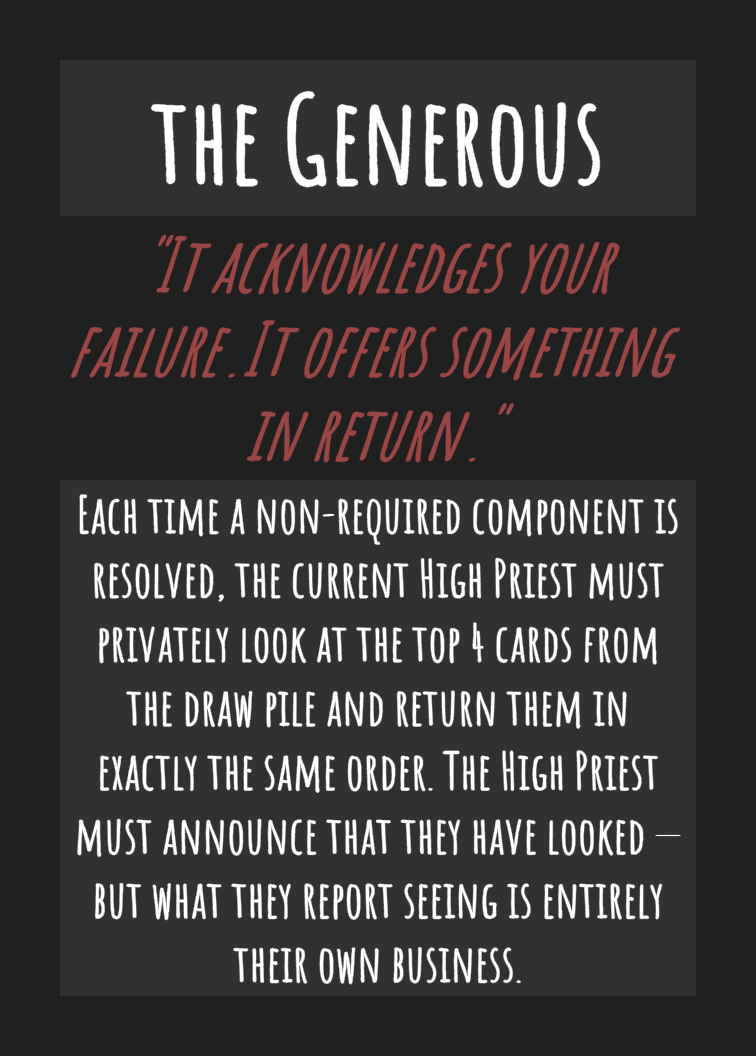
"It acknowledges your failure. It offers something in return."
Each time a non-required component is resolved, the current High Priest must privately look at the top 4 cards from the draw pile and return them in exactly the same order. The High Priest must announce that they have looked — but what they report seeing is entirely their own business.
Inherent sway: Townsfolk · Moderate
The Insecure J4 Omen
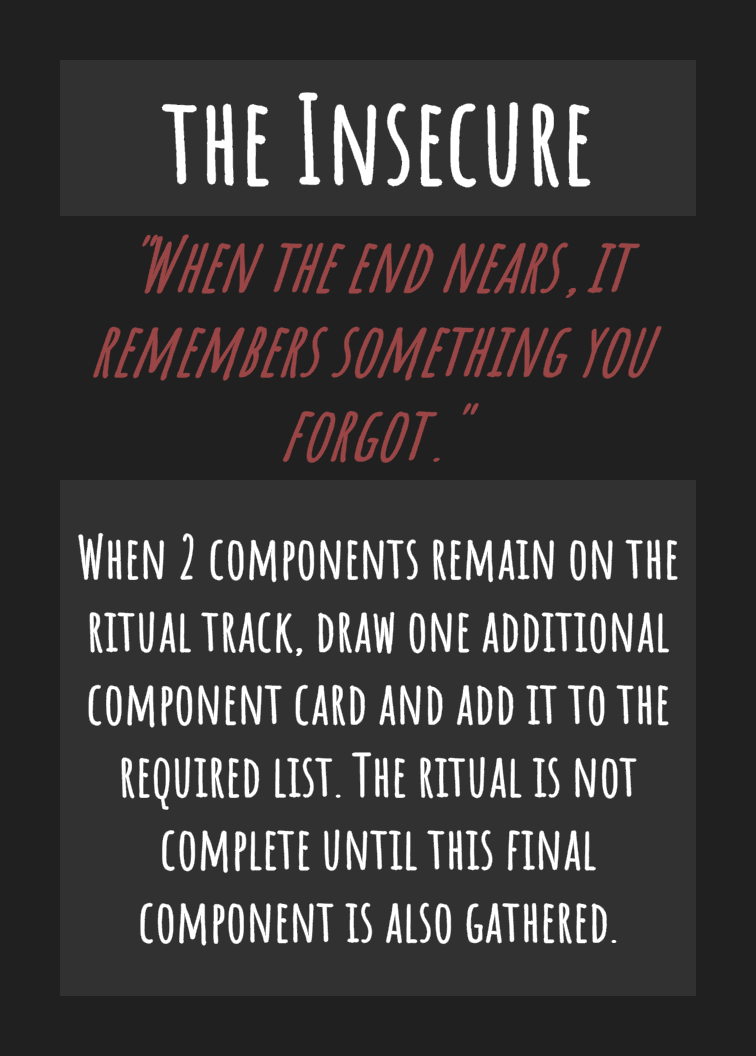
"When the end nears, it remembers something you forgot."
When 2 components remain on the ritual track, draw one additional component card and add it to the required list. The ritual is not complete until this final component is also gathered.
Inherent sway: Townsfolk · Moderate
The Devout J5 Favour
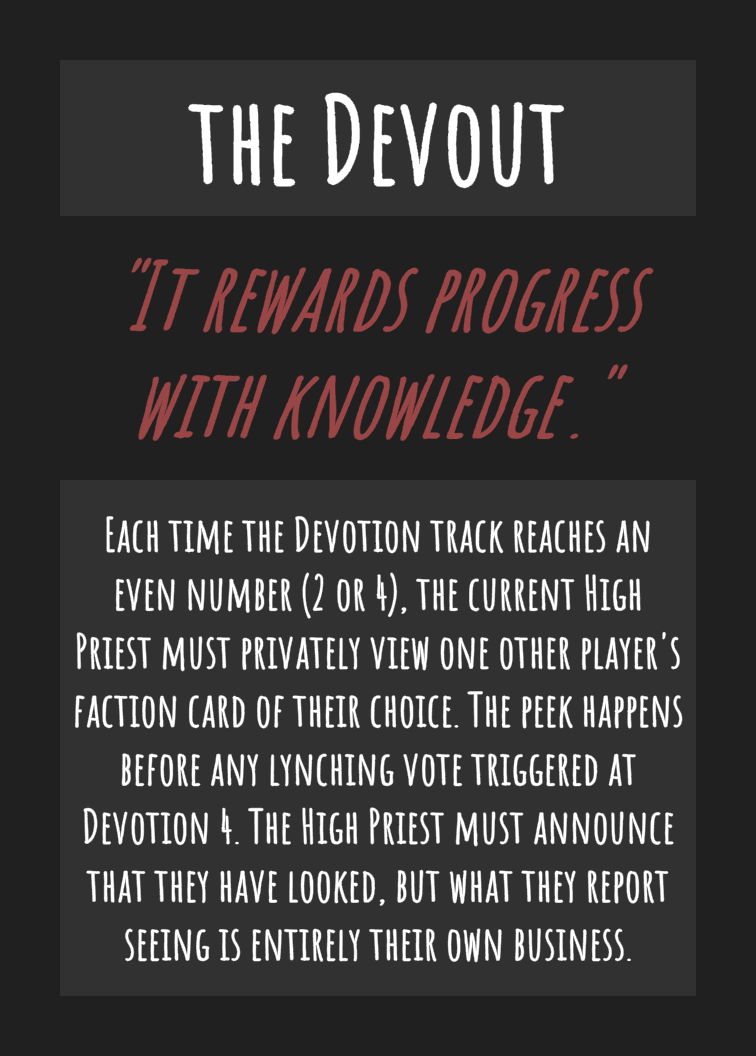
"It rewards progress with knowledge."
Each time the Devotion track reaches an even number (2 or 4), the current High Priest must privately view one other player's faction card of their choice. The peek happens before any lynching vote triggered at Devotion 4. The High Priest must announce that they have looked, but what they report seeing is entirely their own business.
Inherent sway: Cultists/Heretics · Moderate
The Merciful J6 Favour
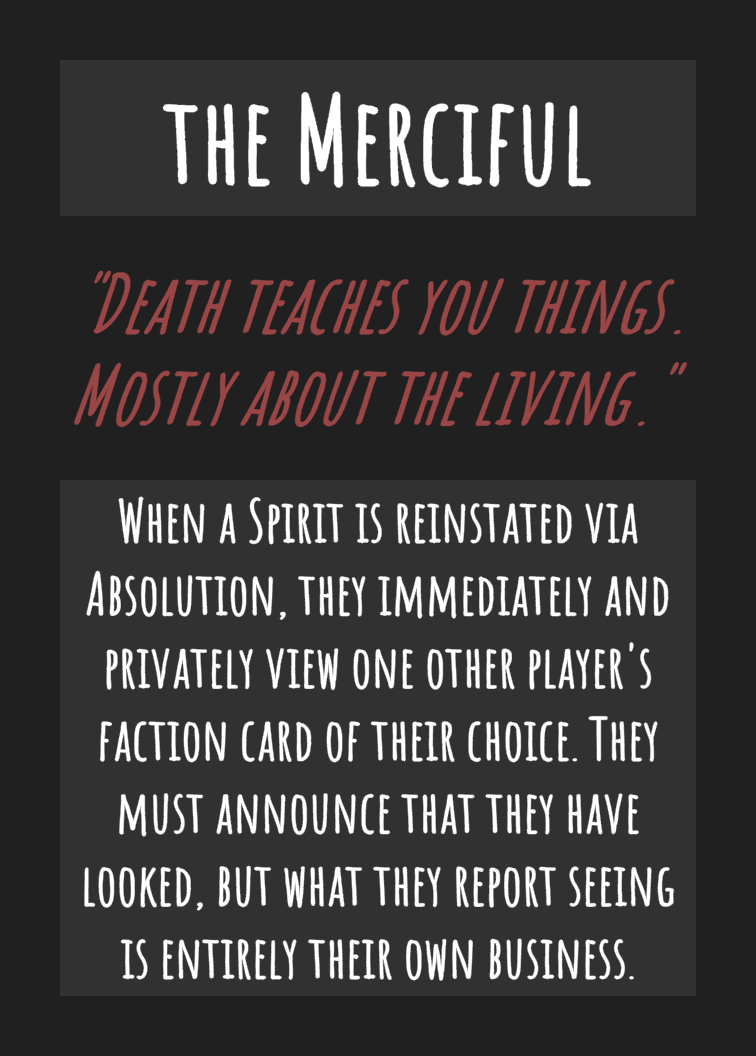
"Death teaches you things. Mostly about the living."
When a Spirit is reinstated via Absolution, they immediately and privately view one other player's faction card of their choice. They must announce that they have looked, but what they
Inherent sway: Neutral · Moderate
The Bureaucrat J7 Wrath
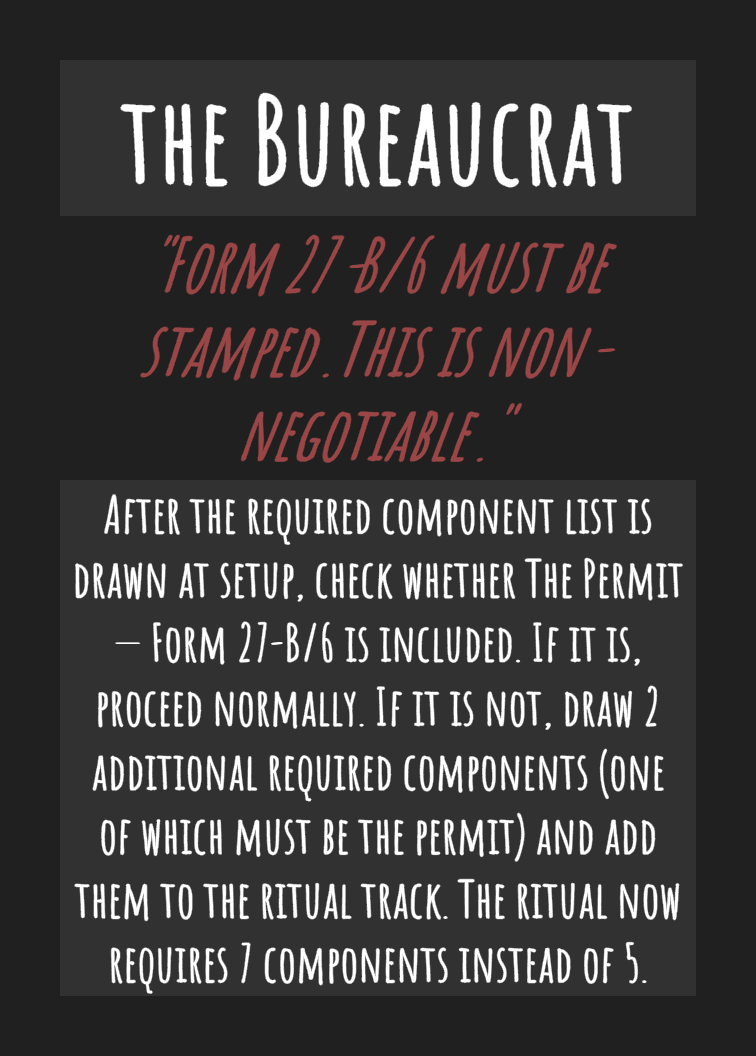
"Form 27-B/6 must be stamped. This is non-negotiable."
After the required component list is drawn at setup, check whether The Permit — Form 27-B/6 is included. If it is, proceed normally. If it is not, draw 2 additional required components and add them to the ritual track — one of which must be the Permit. The ritual now requires 7 components instead of 5.
Inherent sway: Neutral · Mild
The Restless J8 Omen
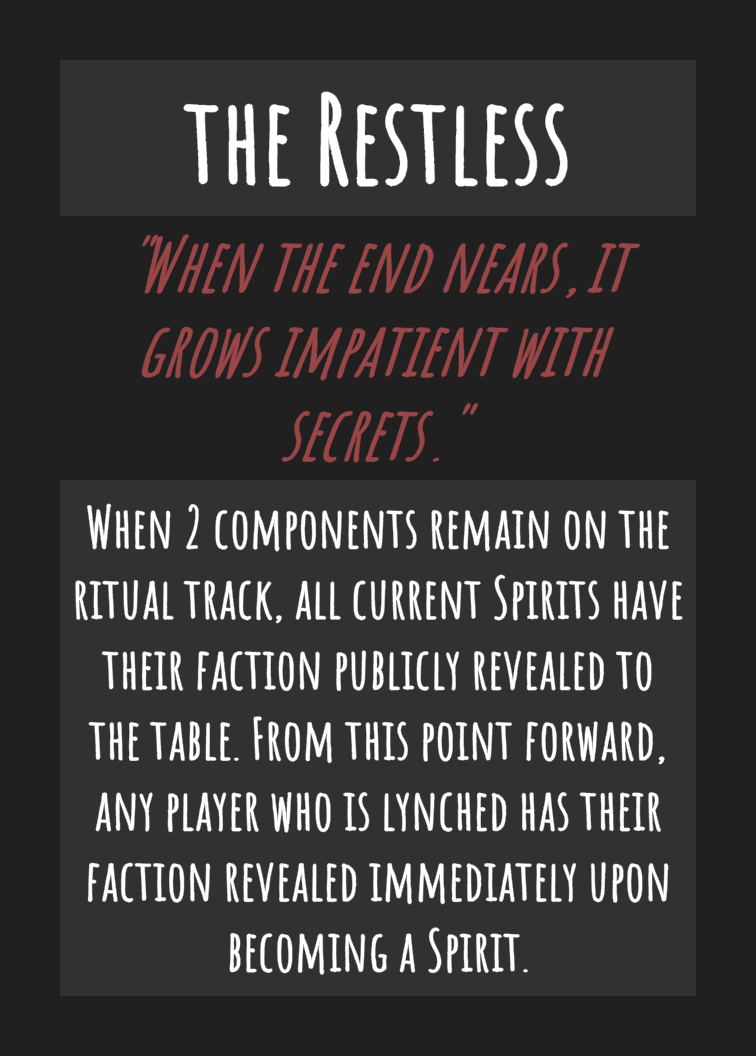
"When the end nears, it grows impatient with secrets."
When 2 components remain on the ritual track, all current Spirits have their faction publicly revealed to the table. From this point forward, any player who is lynched has their faction revealed immediately upon becoming a Spirit.
Inherent sway: Cultists/Heretics · Mild
The Theatrical J9 Omen
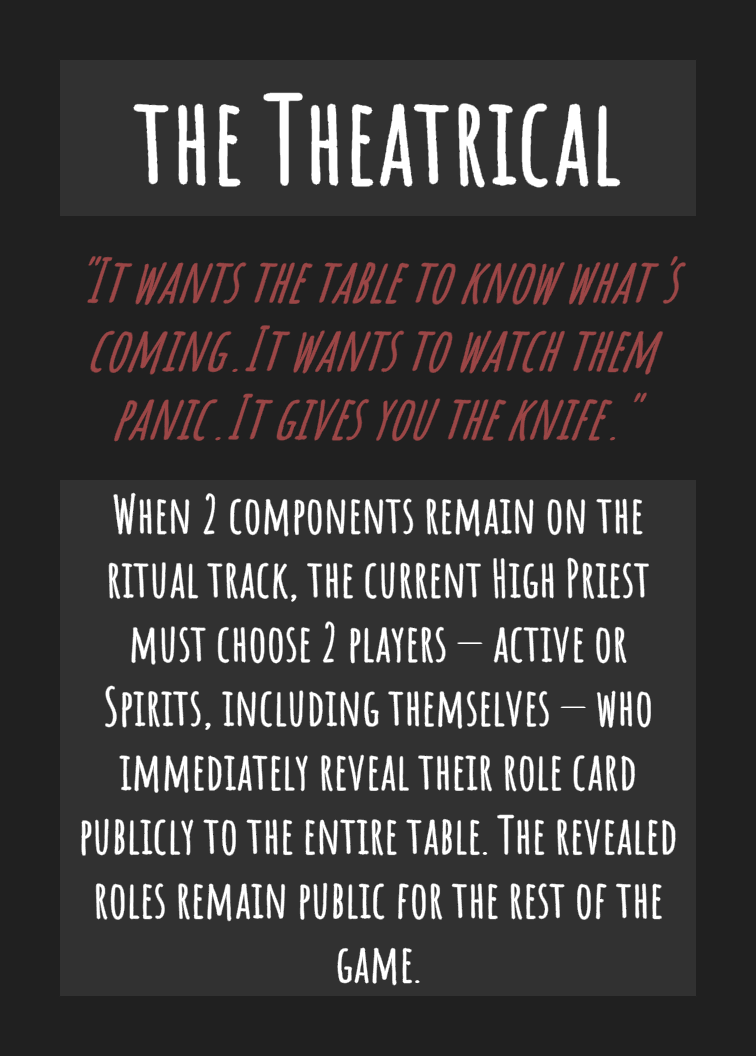
"It wants the table to know what's coming. It wants to watch them panic. It gives you the knife."
When 2 components remain on the ritual track, the current High Priest must choose 2 players — active or Spirits, including themselves — who immediately reveal their role card publicly to the entire table. The revealed roles remain public for the rest of the game.
Inherent sway: Neutral · Moderate
The Hungry J10 Wrath
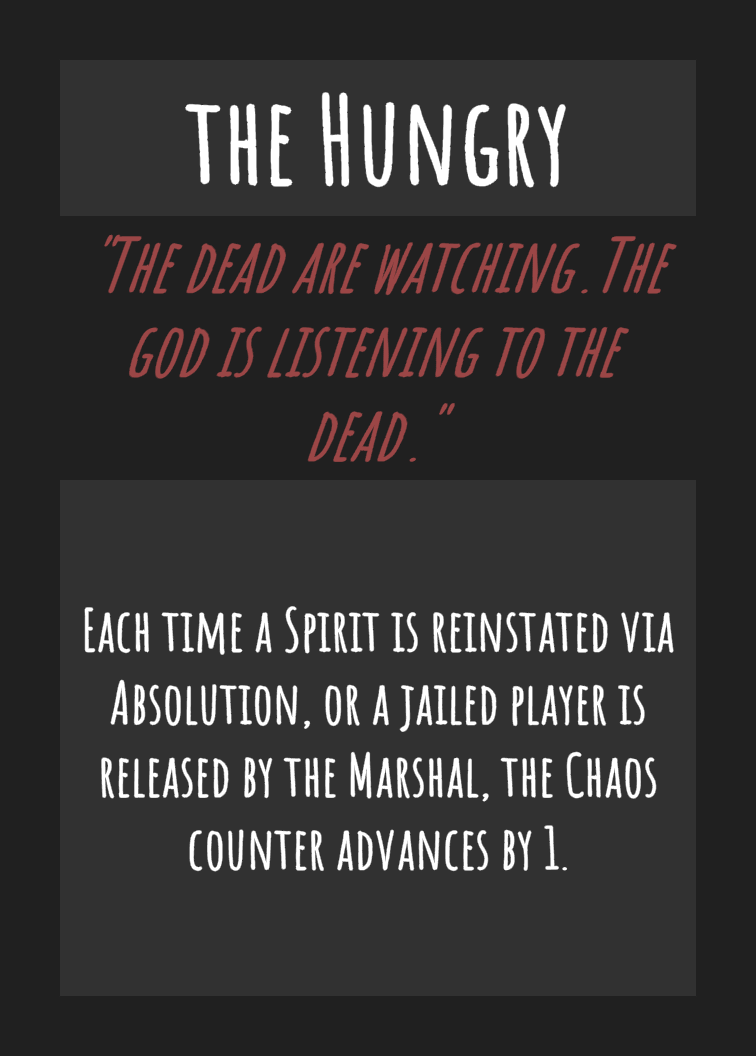
"The dead are watching. The god is listening to the dead."
Each time a Spirit is reinstated via Absolution, or a jailed player is released by the Marshal, the Chaos counter advances by 1.
Inherent sway: Neutral · Mild
Incompatibility Reference
Only Quirk + Judgment combinations may be incompatible. Quirk vs. Quirk and Judgment vs. Judgment conflicts do not exist since only one of each is in play. If an incompatible combination is drawn, redraw the Judgment card.
| If you drew… | Incompatible with… |
|---|---|
| Greldo | the Impatient, the Watchful |
Faction Sway Reference
Each cell shows the result of pairing a Quirk (row) with a Judgment (column). Direction belongs to whichever card has higher severity; equal severities cancel to Neutral. Hover column headers for full names.
| J0 | J1 | J2 | J3 | J4 | J5 | J6 | J7 | J8 | J9 | J10 | |
|---|---|---|---|---|---|---|---|---|---|---|---|
| Q1 | Mild | Mild | Mild | Mild | Mild | ||||||
| Q2 | Mild | Mild | Mild | Mild | Mild | Moderate | Moderate | Mild | Moderate | ||
| Q3 | Moderate | Mild | Moderate | Mild | Mild | Mild | Mild | Mild | |||
| Q4 | Mild | Mild | Mild | Mild | Mild | Moderate | Moderate | Mild | Moderate | ||
| Q5 | Mild | Mild | Mild | Mild | Mild | Moderate | Moderate | Mild | Moderate | ||
| Q6 | Mild | Mild | Mild | Mild | Mild | Moderate | Moderate | Mild | Moderate | ||
| Q7 | Moderate | Mild | Moderate | Mild | Mild | Mild | Mild | Mild | |||
| Q8 | Mild | Mild | Mild | Mild | Mild | ||||||
| Q9 | Mild | Mild | Mild | Mild | Mild | Moderate | Moderate | Mild | Moderate | ||
| Q10 | Mild | Mild | Mild | Mild | Mild |
Example Assembled Gods
Gerald, the Impatient
Q1 Open Congregation + J1 Wrath of Stalled Nominations
Every submission is public, and rejected nominees can't submit components. The table can see exactly who's feeding the pool what — and indecision costs everyone.
Tone: Paranoid and fast-moving.
Nul-Veth, the Insecure
Q2 Missing Components + J4 Hidden Requirement
The deck is stripped bare and then, when you're almost done, something else is needed. The concentrated pool makes every draw feel loaded.
Tone: Procedural dread.
Morreth, the Theatrical
Q5 Hungry God + J9 The Unmasking
Every lynching or jailing forces the High Priest to adjust a tracker — pushing the game closer to or further from the edge in ways nobody else can predict. Then, when two components remain, the High Priest must publicly expose two players' role cards. The table suddenly knows who they're dealing with — and the High Priest decides who gets exposed.
Tone: Tense and revelatory.
Brenda, the Hungry
Q4 Expanding Ritual + J10 Wrath of the Voiceless
Every lynching makes the ritual longer — but every time a Spirit returns via Absolution or a jailed player is released, the Chaos counter ticks up. The congregation must choose between bringing allies back and keeping the Chaos counter in check, all while the ritual keeps growing beneath them.
Tone: Dark comedy escalating into genuine menace.
God Board
The god board is the central play surface. At the start of each game, players assemble tonight's god by drawing one Quirk card and one Judgment card and placing them face-up on the board. The god's name is read aloud once both cards are placed: "Tonight we summon [First Name], [Disposition]."
Standard game: Draw 1 Quirk + 1 Judgment (may be Silence).
First game / introductory: Draw 1 Quirk only. No Judgment slot.
Advanced / experienced tables: Draw 1 Quirk + 1 Judgment, then optionally swap any
one
drawn card for a hand-picked alternative from the deck.
Before starting the game, consult the Incompatibility Reference to check whether the drawn Quirk and Judgment are compatible. If flagged as incompatible, redraw the Judgment card and check again.
The board holds the Quirk and Judgment card slots, the Devotion track (0–8), the Disruption track (0–8), the Chaos counter (0–3), the ritual progress track (5–8 slots for required component cards), and designated slots for the draw pile and discard pile.
The draw pile is the shuffled face-down stack of component cards players draw from each round. The discard pile is a separate face-down stack where discarded cards are placed during play — both cards discarded by chosen players during Component Submission, and the unselected pool cards discarded by the High Priest after the Officiant Phase. When the draw pile is exhausted, shuffle the discard pile to form a new draw pile.
Board Layouts by Player Count
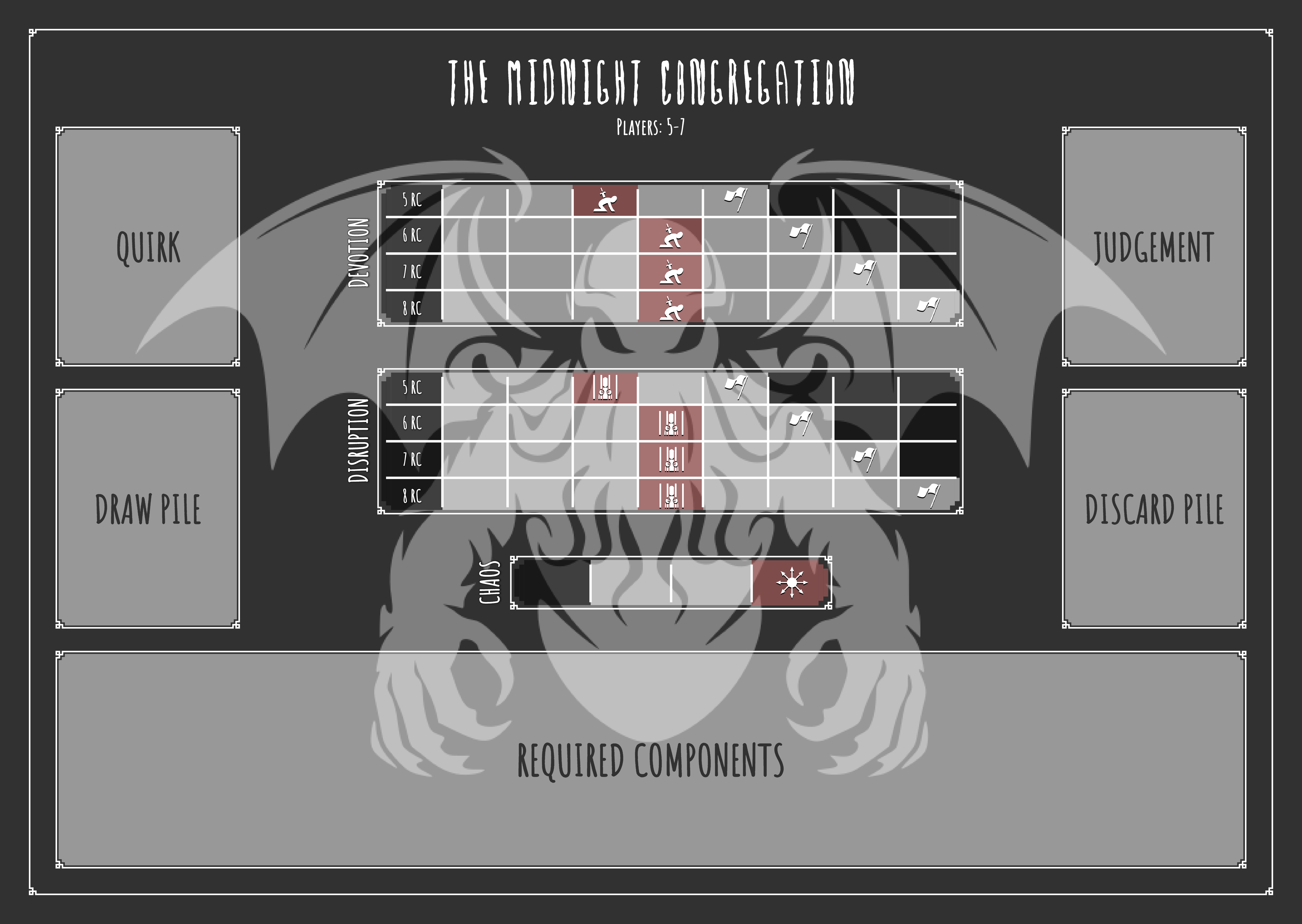
Small Board (5–7 players)
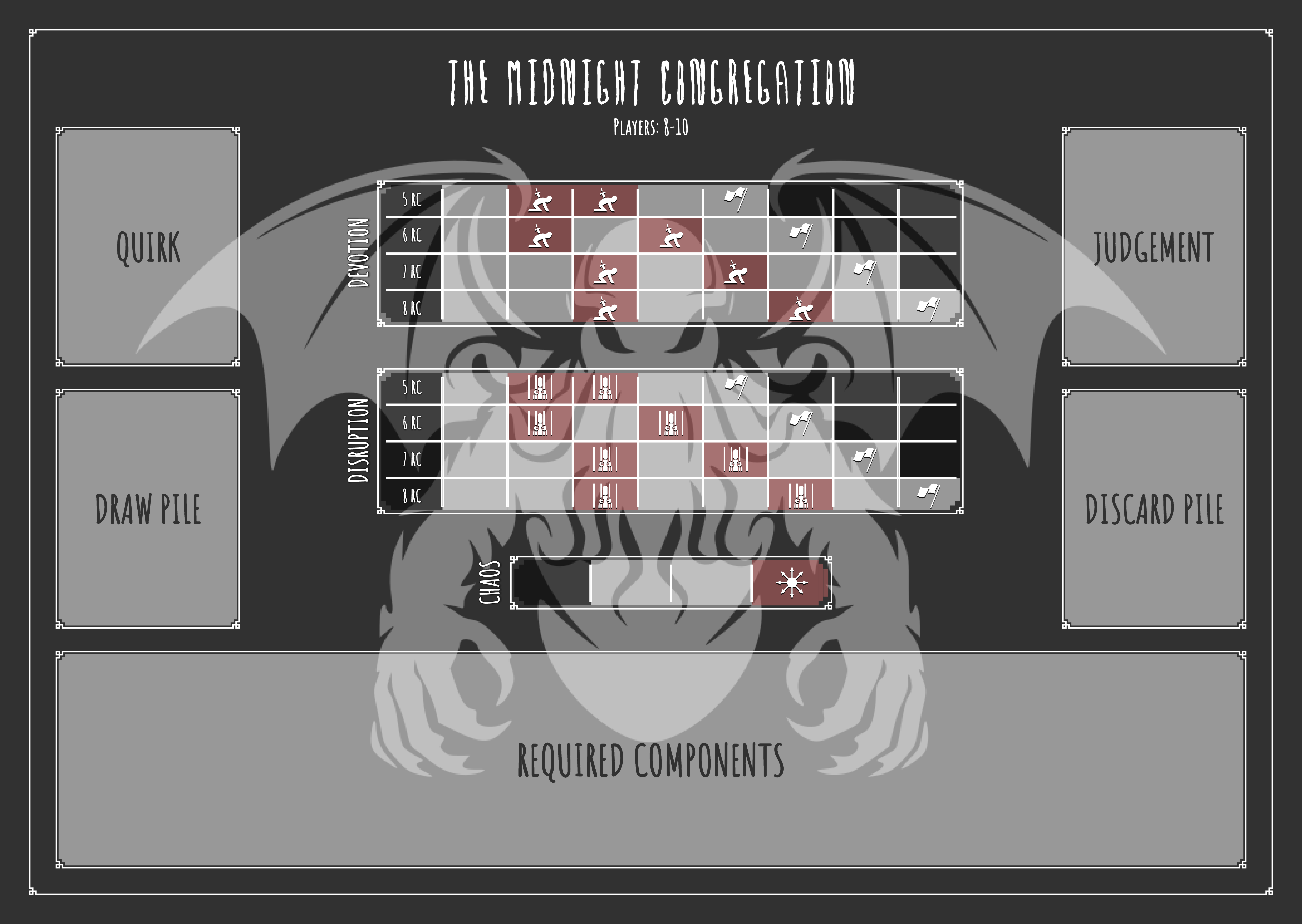
Medium Board (8–10 players)
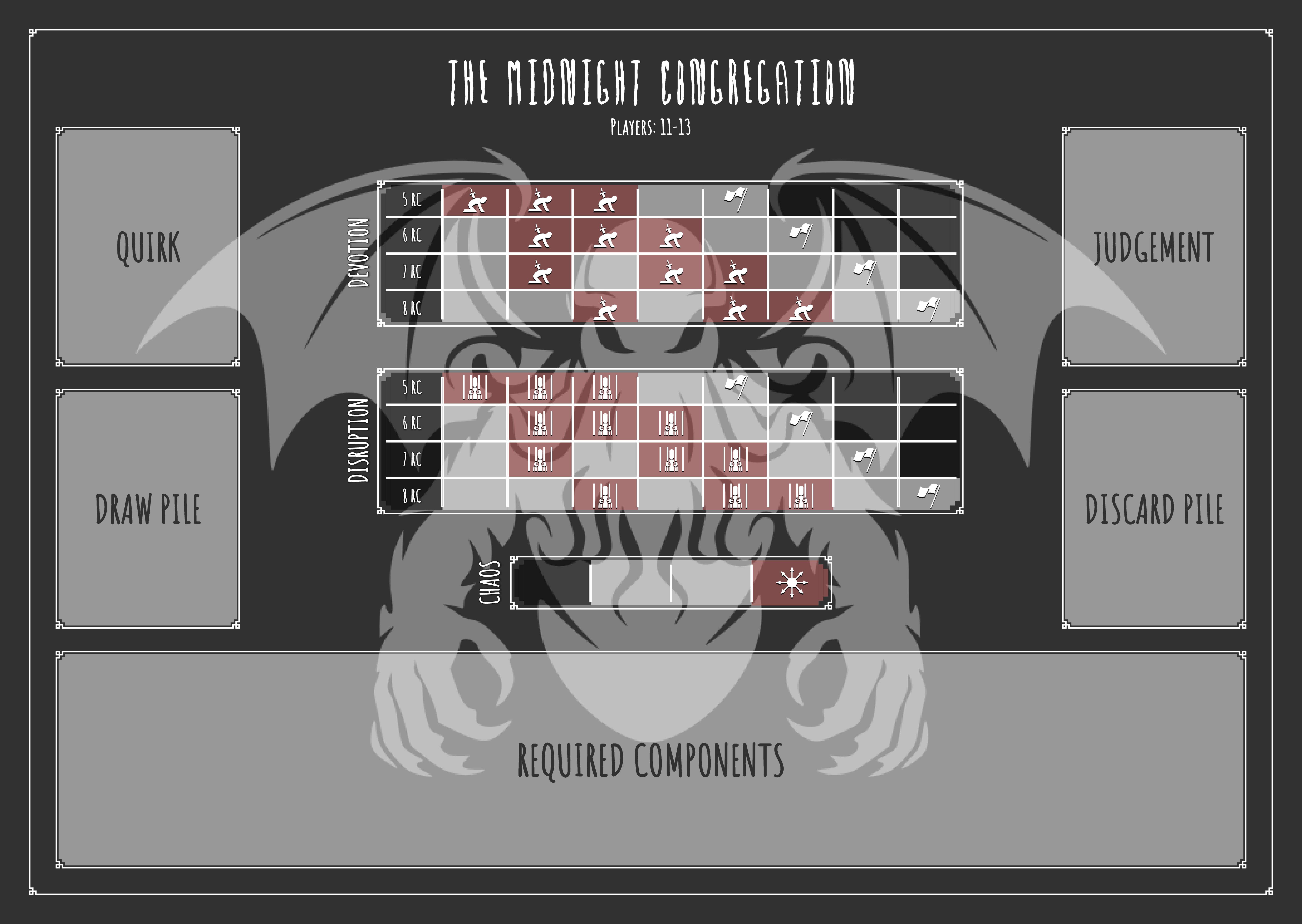
Large Board (11–13 players)
2. The Three Factions
Faction Overview
| Faction | Size | Goal | Knows allies at start? |
|---|---|---|---|
| The Cultists | hidden cell | Fill the Devotion track and claim the ritual in the finalization round | No |
| The Townsfolk | majority | Fill the Disruption track before the Devotion track fills | No |
| The Heretics | small cell | Fill the Devotion track and seize the ritual in the finalization round | No |
The signature twist — the Cold Open. Nobody knows anyone, not even their own faction. The hidden teams must find each other through play. Which component you submit to the High Priest is your secret handshake: feed the right one and hope a fellow Cultist notices without the Townsfolk clocking you. "Who's even on my team?" is now part of the puzzle.
The frenemy tension. Cultists and Heretics both want required components resolved — filling the Devotion track is their shared path to the finalization round. The Townsfolk, meanwhile, want non-required components resolved to fill the Disruption track and win outright. Devotion hitting certain trigger positions cause a lynching vote; Disruption hitting trigger positions causes a jailing. Triggers scale with board size and required components in play.
Faction Setup Chart
| Players | Townsfolk | Cultists | Heretics |
|---|---|---|---|
| 5 | 2 | 2 | 1 |
| 6 | 3 | 2 | 1 |
| 7 | 3 | 2 | 2 |
| 8 | 4 | 2 | 2 |
| 9 | 4 | 3 | 2 |
| 10 | 5 | 3 | 2 |
| 11 | 5 | 3 | 3 |
| 12 | 6 | 3 | 3 |
| 13 | 6 | 4 | 3 |
Design intent: Cultists + Heretics always equal or outnumber Townsfolk by at most 1, compensating for Townsfolk's inherent advantage in non-required component numbers. Cultists get one extra member over Heretics when the split is uneven. Numbers are a starting point — expect to retune after playtests.
3. The Ritual System
Setup
- Prepare one envelope per player containing their faction card and role card — deal one envelope to each player secretly. Every game always includes one Marshal (Townsfolk), one Custodian (Cultists), and one Defiler (Heretics); remaining role cards within each faction are ordinary Townsman, Cultist, and Heretic cards.
- Deal one power card to each player separately. This card is publicly placed face-up. Power role inclusion scales with player count — 5–6 players: Medium only; 7–9 players: Medium + Oracle; 10–13 players: Medium + Oracle + Inquisitor. All remaining power cards are Congregants.
- Draw 1 Quirk card and 1 Judgment card, consult the incompatibility reference, redraw if necessary, and place them face-up on the god board. Before continuing, consult the Incompatibility and Faction Sway tables to check whether the combination works for your group — redraw either card if needed.
- Shuffle the full 45-card component deck, and draw 5 components to form the Required List, placed face-up on the ritual track. Some Quirk cards modify this step — consult the active Quirk card before drawing.
- Shuffle the remaining 40 cards into a draw pile.
Devotion & Disruption
Devotion and Disruption are generated entirely by component resolution each round:
- Required component resolved → Devotion +1
- Non-required component resolved → Disruption +1
Both tracks run from 0 to the number of required components currently in play (5 by default, up to 8 with certain Quirk and Judgment cards). Required components may be resolved in any order — when a required component is resolved, a resolution token is placed on it on the ritual track. The component remains visible and can still be played again — but resolving an already-resolved required component advances neither Devotion nor Disruption.
- Devotion fills → Townsfolk are excluded and the Finalization Round begins between Cultists and Heretics.
- Disruption fills → Townsfolk win immediately.
Lynching, Jailing, and Chaos
Devotion hitting a trigger position triggers a lynching vote immediately after resolution. All active players simultaneously point at the player they accuse. The player with the most fingers pointed at them is lynched and becomes a Spirit. In the event of a tie, the High Priest chooses. Existing Spirits are immune from being pointed at.
Disruption hitting a trigger position triggers a jailing immediately after resolution. The table closes their eyes and the Marshal secretly places the jail token on one active player of their choice. The Marshal's identity is not revealed. If the Marshal has already been lynched, the table votes on who to jail by majority with eyes open. Jailed players are completely out of the game until released by the Marshal at the start of any round, or until 3 turns have passed — whichever comes first.
The Chaos counter advances by 1 each time a nomination is rejected. When it reaches 3, a random component card is drawn from the draw pile and resolved immediately (Devotion or Disruption as normal). The Chaos counter resets to 0 only when this occurs.
Trigger positions for Devotion and Disruption are equal and depend on the board size and number of required components in play. The Chaos counter always triggers at 3 regardless of board size.
| Tracker | Required Components | Small (5–7 players) | Medium (8–10 players) | Large (11–13 players) |
|---|---|---|---|---|
| Devotion (lynching) Disruption (jailing) |
5 | 3 | 2, 3 | 1, 2, 3 |
| 6 | 4 | 2, 4 | 2, 3, 4 | |
| 7 | 4 | 3, 5 | 2, 4, 5 | |
| 8 | 4 | 3, 6 | 3, 5, 6 | |
| Chaos (random component) | — | 3 | 3 | 3 |
Spirits
When a player is lynched they become a Spirit — still present at the table but operating under strict limitations.
Spirits CAN
- Communicate privately with the Medium during the Power Window if the Medium chooses to commune rather than call Absolution
- Be targeted by the Medium for Absolution
- Have their faction revealed by J8 (Omen of Exposure)
- Have their role revealed by J9 (The Unmasking)
- Retain the Medium power role if they held it before being lynched
Spirits CANNOT
- Vote on nominations
- Be nominated as High Priest
- Participate in lynching votes
- Speak to or communicate with any active player
- Submit component cards
- Use power roles (except the Medium)
A Spirit who is reinstated via Absolution returns to full active status immediately, recovering all abilities except any power role uses already spent before lynching. A lynched Medium retains their power and may call for their own Absolution.
Jailed Players
When the Disruption track hits a trigger position, the table closes their eyes and the Marshal secretly places the jail token on one active player of their choice. The Marshal's identity is not revealed by this action. Releasing a jailed player publicly reveals the Marshal's role. If the Marshal has already been lynched, the table votes by majority with eyes open instead. When the Marshal is lynched, they must also announce their role. Jailed players are released automatically after 3 turns if the Marshal has not done so first. The Marshal has no power in the Finalization Round, as Townsfolk are excluded from it entirely.
Jailed Players CAN
- Receive private visits from other players — with the Marshal's permission, and the Marshal is present
- Be released by the Marshal at the start of any round — this publicly reveals the Marshal's role
- Be released by the Final Invocation component without the Marshal's approval
- Retain their full active status upon release
Jailed Players CANNOT
- Vote on nominations
- Be nominated as High Priest
- Participate in lynching votes
- Submit component cards
- Use power roles
Jailed players are not Spirits. They retain their full active status the moment they are released.
The Round Loop
In the first round, the first High Priest is chosen randomly. The High Priest cannot serve two consecutive rounds. Each round proceeds as follows:
- Nomination. The role passes clockwise to the next active player, who becomes the nominee. Some component card actions override which seat the next High Priest nominee comes from — if one was resolved last round, apply it here instead of the default clockwise succession.
-
Confirmation Vote. Table votes yes/no on the nominee.
- Rejected? Chaos +1. Nomination continues clockwise.
- Chaos counter reaches 3 → a random card is drawn from the component deck and resolved immediately — required or not, Devotion or Disruption as normal. Chaos counter resets to 0.
- Player Selection. The confirmed High Priest publicly points to up to 2 active players who will participate in this round's ritual. The High Priest may not select themselves, Spirits, or jailed players. The High Priest must always select the maximum number of eligible players available — choosing fewer than 2 is only permitted if fewer than 2 eligible players remain. All other active players draw no cards and submit nothing this round. Some component card actions override which players must be selected — if one was resolved last round, the High Priest must follow its player selection instead of choosing freely.
- Power Window (Inquisitor). If the Inquisitor wishes to use their power this round, they must do so now — before component submission. The Inquisitor names one of the chosen players and publicly announces their punishment: the target must either skip their submission entirely, or submit both their drawn cards with no discard.
- Component Submission. The chosen players each draw 2 component cards, secretly discard one face-down onto the discard pile, and pass one face-down to the High Priest. Players affected by the Inquisitor follow their assigned punishment instead.
-
Officiant Phase. The High Priest shuffles all submitted components before
looking
at them, unless a Quirk or Judgment card rule specifies otherwise. The High Priest then
privately
reviews them, selects one, and reveals it to the table. The remaining unselected cards are
discarded face-down onto the discard pile. This is the central
claim‑and‑lie: "It was the only required component anyone gave me"
— but
nobody can verify what the pool contained. The revealed component is checked against the
Required
List:
- On the list, not yet resolved → place a resolution token on it. Devotion +1.
- On the list, already resolved → no token, no change to either tracker. Neither Devotion nor Disruption advances — a safe play for Cultists and Heretics when options are scarce.
- Not on the list → no token. Disruption +1.
- Lynching Check. If the Devotion track hits a trigger position for your board and current required component count, a lynching vote fires. All active players point simultaneously — most fingers = lynched, becomes a Spirit. High Priest breaks ties. Spirits are immune. See Lynching, Jailing & Chaos for the full trigger table.
- Jailing Check. If the Disruption track hits a trigger position (same positions as Devotion), the table closes their eyes and the Marshal secretly places the jail token on one active player of their choice. The Marshal's identity is not revealed. Releasing a jailed player later publicly reveals the Marshal's role. If the Marshal has already been lynched, the table votes by majority with eyes open instead.
- Power Window (Oracle & Medium). Oracle activates first, then Medium.
- Completion Check. If the Devotion or Disruption track reaches the number of required components currently in play, the Finalization Round begins.
- Replenish. The chosen players' discarded component cards are shuffled back into the draw deck.
Endgame & Victory
Completion
The ritual completes when either tracker reaches the number of required components currently in play:
- Devotion fills — all required components have been gathered. Townsfolk are excluded and the Finalization Round begins between Cultists and Heretics.
- Disruption fills — the number of non-required components resolved equals the number of required components in play. The ritual is too corrupted to continue. Townsfolk win immediately.
The Finalization Round
Once Devotion fills, Townsfolk are excluded and the Finalization Round begins between Cultists and Heretics only. This round follows a different structure:
- Nomination — the role passes clockwise to the next active player as normal.
- Confirmation Vote — the table votes yes/no. If rejected, nomination continues clockwise. If the Chaos counter reaches 3, an immediate pointing vote is held — all active Finalization Round players point simultaneously and the most-pointed player is lynched. The Chaos counter resets to 0.
-
Finalization — the confirmed High Priest acts according to their faction:
- Cultist High Priest — calls the god. Cultists win.
- Heretic High Priest — seizes the ritual. Heretics win.
Win Conditions
| Outcome | Winner |
|---|---|
| Cultist High Priest finalizes the ritual | Cultists |
| Heretic High Priest seizes the ritual | Heretics |
| Disruption fills before Devotion | Townsfolk |
4. Open Tuning Questions
General
- Component pool pressure — with 1-in-3 cards being required at baseline, does the High Priest's lie feel meaningful? If required components are too easy to find, consider reducing copies from 3 to 2.
- Cold‑open viability at low counts — at 5–6 players the hidden cells are tiny and only the Medium is in play. Finding faction allies relies entirely on reading component submissions and nomination patterns. Consider whether an additional coalescing mechanism is needed at low player counts.
- Chaos resolution — when the Chaos counter reaches 3 and a random component is drawn and resolved, it generates Devotion if it is a required component, or Disruption if it is not. This follows the same resolution rules as a normal round.
- Duplicate required components — if a required component is drawn but already marked off, it currently generates Disruption. Consider whether it should be neutral instead.
- Finalization pacing — if the Chaos counter repeatedly triggers during the Finalization Round, factions could be significantly thinned by forced lynchings before a High Priest is confirmed. Consider whether a cap on Chaos-triggered lynchings is needed, or whether thinning the factions is an acceptable dramatic consequence.
Quirks
- Q1 (Gerald — Open Congregation) — with all submissions public, does the High Priest's selection still feel like a meaningful lie, or does full visibility make the Officiant Phase too transparent?
- Q3 (Kevin — Counter-Nomination) — at low player counts, the mandatory counter-nominator may always be the same player if the High Priest rotates predictably. Does seat position become too deterministic?
- Q4 (Brenda — Expanding Ritual) — capped at 2 extra components, but combined with J7 (Stamped Form) could reach 8 required components. Consider whether 8 feels too long at low player counts.
- Q5 (Morreth — Hungry God) — the mandatory tracker adjustment after each lynching or jailing gives the High Priest significant influence over the game state. Consider whether this power is too strong at low player counts where lynchings and jailings are less frequent, or too swingy at high player counts where they occur more often.
- Q6 (Phelgoras — Carried Offering) — carrying a card between rounds could lead to hoarding strategies that feel passive. Consider whether a hand size cap is needed.
- Q8 (Orrindel — The Boon) — the 6th required component plus 3 public reserve cards may make the ritual feel bloated. Consider whether the Boon reserve should replenish.
- Q9 (Greldo — Tournament) — at low player counts, RPS tournaments resolve very quickly. At high player counts they could take a long time. Consider a time limit.
Judgments
- J1 (Impatient — Wrath) — rejected nominees sitting out submissions reduces the pool significantly at low player counts. Consider whether this applies to both nominees under Q3.
- J3 (Generous — Favour) — the High Priest peeking 5 cards after every Disruption resolution could give them significant advance knowledge at high Disruption counts. Consider limiting to once per round.
- J5 (Devout — Favour) — the High Priest peeking a faction card at Devotion 2 and 4 rewards whoever holds the role at those specific moments. Consider whether this creates an incentive to time nominations around Devotion thresholds.
- J7 (Bureaucrat — Stamped Form) — adding 2 components when the Permit isn't drawn extends the ritual significantly. Combined with Q4 or Q8, the ritual could hit 8 components.
- J10 (Hungry — Wrath) — each Absolution advancing the Chaos counter may discourage the Medium from using their power at all if Chaos is already high. Consider whether this creates a perverse incentive.
Roles
- Marshal — at 5–6 players, jailing only triggers at Disruption 5, meaning the Marshal may only get one jail opportunity per game. At higher player counts with more triggers, consider whether the Marshal's cumulative jails become too powerful. Also consider: what happens if the Marshal is lynched very early before any jailing triggers fire?
- Custodian — nullifying one Disruption increment and jailing is powerful but one-use. Consider whether the timing — immediately after resolution — gives enough reaction time at a live table.
- Defiler — double vote weight in the Finalization Round is strongest in close votes. At low player counts with fewer Cultists and Heretics in the Finalization Round, it could be decisive. At high counts it may be negligible.
Power Roles
- Oracle — 2 uses across the whole game may feel too scarce at high player counts where the cold open takes longer to resolve. Consider scaling uses with player count.
- Inquisitor — forcing a player to skip submission or submit both cards affects the pool size. At low player counts, skipping submission removes a significant percentage of the pool. Consider whether the punishment scales appropriately.
- Medium — 2 successful Absolutions is tight. With J10 advancing the Chaos counter each time, the Medium may be reluctant to use both uses. Consider whether J10 + Medium creates a functional deadlock.